Wednesday, July 6, 2016
Nonsense
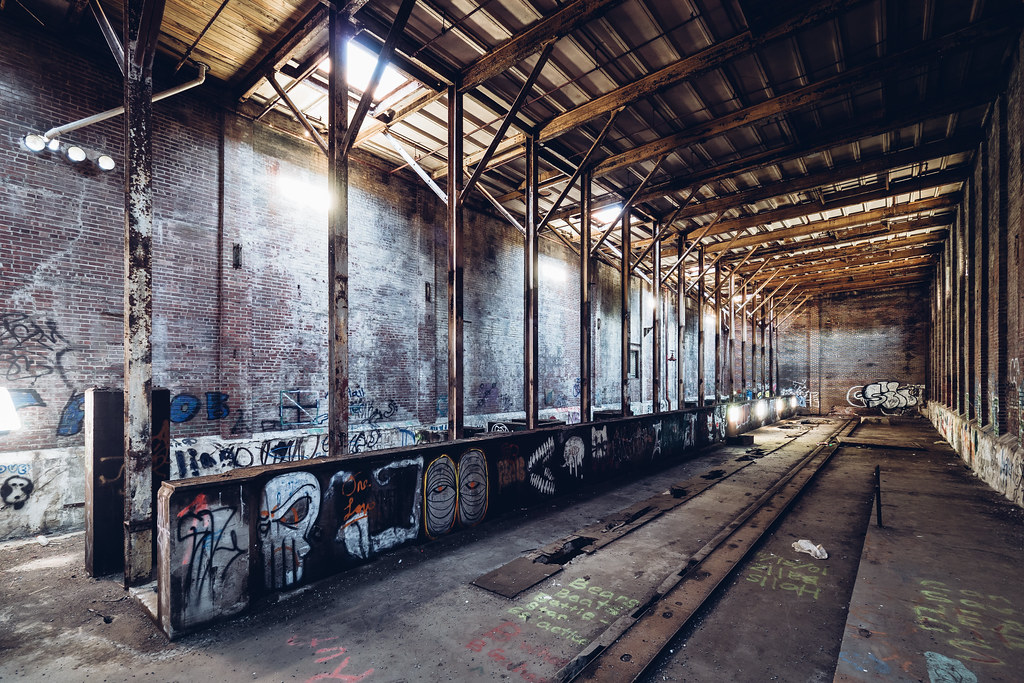
Most of the time I feel like these steel beams. Rigid, straight, and orderly.
But in the end, I really make no goddamn sense at all.
Fantasy City
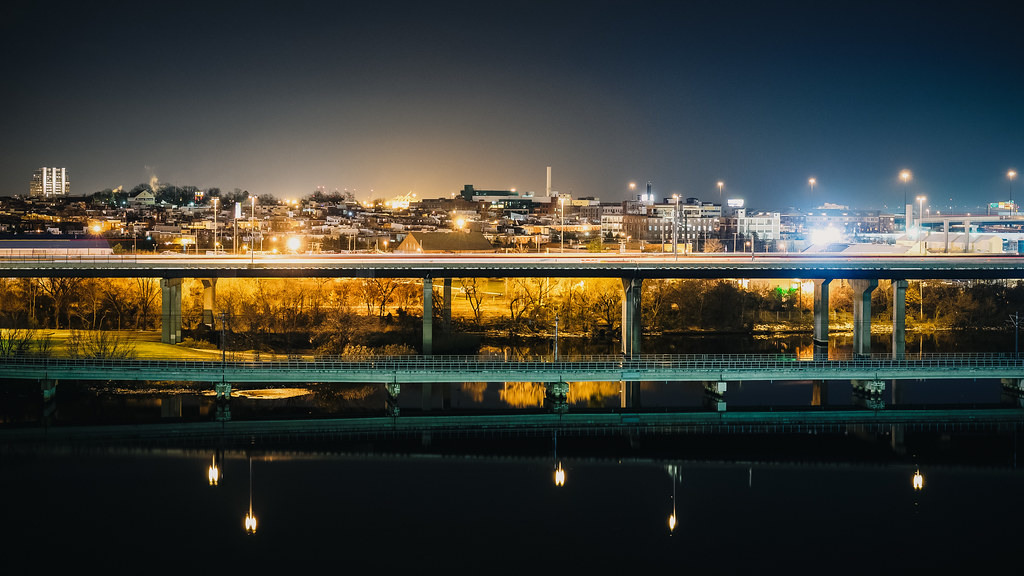
There's a city that recurs with some frequency in my dreams. It's much like Tim Burton's imagined visage of Gotham City, with many high rising and interlaced highways, winding in and out of each other going in every which direction. It's a fascinating place to me for several reasons, let alone the intricacy of the architecture. Frankly, it seems odd to me that I would ever have a locale that repopulates in a dream state, ever. That said, I've dreamed this city's landscape maybe 5 times, at most.
I've only ever seen it at night, and every time the perspective from which it is perceived is aloft 13 stories or so up on the highway, with enough tall buildings to look up toward whilst knowing there is substantial level below to which I pay no attention. I'm simply above, not quite atop the edifices towering to my flanks but enough to know I want to rise higher, to rise above them. The highway street lights are all a dull and vapid yellow, while every building bellows forth with a striking blue, letting me know I'm aware of the muck and mire of a pedestrian perspective despite seeing the brilliance and the difference of an echelon above my own.
Remembering this dream, this imagined city, takes me back to nights spent driving back home in the back of my parents' car, when we would visit Catholic Charities in the process of adopting my sister. I was maybe 12 or 13 at the time, and each venture involved a drive into Baltimore, a city which I did not know nor understand at the time. But I was always fascinated by the play of shadows on my legs and the back seat during the trip, usually listening to some ambient movie soundtrack on compact disc while dumbly being carried along. I understood nothing, not about what was going on, not about where I was. Absolutely nothing made any cohesive sort of sense, but I didn't care. I was content to watch the shadows crawling up my legs in the dark, although in hindsight it was more realistically light doing the crawling.
That fascination bred something in me, something long lasting and pervasive. I can hardly spend any trip in the car not keenly aware of how the shadows play against the interior. Even super subtleties like how the scratches in my glasses carry bloom and undefined flares of light in a variety of forms. I am aware of all these things, and they are somehow pertinent to me, to how I define my experience of life, yet I don't think I will ever be able to express them properly. They will never be subtleties embraced as pervasively influential experiences. And that makes me sad, to a degree, as the impact of such nonsensical minutae strikes me as something that could deliver a greater appreciation of the smallest of things to a great audience. But that audience is not me, it is not a body which has endured the same experiential transformations I have, and though that is not a bad thing, it precludes the presumption that it will ever appreciate such subtleties in at all the same way.
I desire that audience, though. That unicorn of a thing, a body of open eyes that might get what I'm trying to express in exactly the way I intend to express it. I suspect it's not a thing that ever genuinely exists, as we're all different people, shaped by different experiences and biased by different perceptions. But I will always hope for just one body to even silently get it. Someone who also happens to find the same fascination with how the shadows creep up their legs in the car in the dead of night. Someone who also dreams of that fantasy Urbana, the city of highways and unattainable goals. I'm hoping for my though twin.
Yet at the same time I hope he doesn't even exist.
Monday, July 4, 2016
Where You Are is Where You'll Be
A Table of Prints
Spent this weekend in Virginia with Rob and Kevin, a trip predicated on a lot of 1-off tradition (considering we've only ever made the excursion once before). The original expectation foresaw the outing being an exercise of photography in the practical sense, and to a measure it was, however it also functioned as a remarkably effective conduit for introspection amid safe company. Despite the less-than-ideal weather, I believe Rob and Kevin came out of the trip with photos they'll be proud of until we inevitably one-up ourselves next year (or even sooner, ideally). Myself, I spent more of the trip internally struggling with concepts of "Why" and "What".
I will preface this self-analysis with the clear bias of envy I have specifically of Kevin's workflow. Rob and I have been photographing for a very long time by comparison, and we've established a rigid process that lends itself well to the working engagements we shoot. The business-end of things. Furthermore, Rob seems entirely comfortable with that workflow, and has adapted it well to his personal work in posting and sharing. Both of them seem entirely comfortable with what they're doing, so I find it frustrating that I cannot seem to discover the same comfort in my own process. I am not doing something I want to be doing. I am not accomplishing the things I idealize in the work of others. And I know what it is, have known for plenty long a time, but I'm still not doing it.
Kevin's workflow is entirely mobile. He is more than comfortable to rely on the tools available to him on his phone, and he produces amazing images even within those markedly limited bounds. Rob and I do this to some extent, but the end goal for us is always a sternly managed edit in Lightroom once we're back home on the desktop. Rob is comfortable in that process, but my own creative drive basically dies the second I sit at my desk at home. The enormity of the task of processing images isn't so much the issue, but self-imposed standards stall execution of publishing, what images do break that stall are daunting to share in such a way as to gather an audience, and frankly I don't entirely understand what the point of cultivating that audience even is anymore. It's the first trap of any artist who ever got the faintest taste of success... Not doing art for oneself, but rather doing it for the audience. The fallacy of that logic is clear. The audience was originally attracted to the artist for the work done for the self, so any variance from that is effectively a failed attempt at masturbation. How stupid.
This entire weekend was an exercise in masochism. While I enjoyed my company of friends, I did not enjoy my company of self. I enjoyed the experimental verve Kevin and Rob both exhibited with their photography this weekend, and felt frustration that such creative freedom and vigor had escaped me. Watching Kevin exercise his muse, especially, reminded me of the freely expressive drive I embodied on afternoons at Starbucks in 2009, and the experimental curiosity of evenings on the porch during the same period trying to capture lightning, or setting up shoddy "studio" setups with disgustingly stained bed sheets tacked to the wall with 100 watt pot lights. I see it in his photos every time we shoot together, that spirit of creativity. I long for it, but am trapped in the defeatist thinking that it has moved on.
Something needs changing.
Saturday, June 18, 2016
A World Without People
![]() |
| Abandoned paper mill in Pennsylvania. Olympus EM1 with M. Zuiko 7-14mm f/2.8, 0.6" at f/5.6. |
Days like this I really don't know what to do with myself.
Business is shrinking. I'm okay with that. Jobs are coming in gradually, still largely hindered by less than willing clients fed to me through contracting firms. I'm not worried about the state of the business, it's inevitably going to contract some years, especially with my passive approach to running the business in general. That said, these weekends of available down time... I still don't know how to manage myself outside the scope of relentless work. As a result, I often find myself dwelling for hours at a time, almost as if I'm waiting for a job to magically spring up on a moment's notice. Waiting for this mystical moment's notice labor, the echo chamber of my head analyzes the state of the world and doesn't understand how anything ever got so complex at the surface level.
Last weekend I ventured up to Pennsylvania with some friends to indulge in some urban exploration through old locations. Easy locations. And the immediacy with which I felt impassioned and filled with the vibrancy of life struck noticeably. There is a muse there, in those dank locations replete with hazards and filth, and I miss it greatly. While in the car between locations, I postulated with Rob and Kyle (my cohorts for the day) that the hidden gem of appeal in such environmental submersion is, much as every other hobby taken to dedicated lifestyle and craft, a sort of escapism. And especially amid the calamitous happenings and ensuing battle for narrative control, it is an escapism I feel a desperate, continual need for. The fantasy of a life after people. Where nature does as it will in the slow reclamation of its territory from the brutal impact of man. Where the silence and solitude is, for a change, genuine. Where I can be reminded that, independent of the inanity of man's embattled stance with the world and with itself, things will move on and adapt quite pleasantly in the absence of our influence.
It's obvious and cliche as hell. It's also remarkably easy to forget and lose sight of. And while it can be quite easily stated as a concept, it's a very different experience to immerse oneself in the fantasy, to imagine yourself as a lone observer of that environment put to practice. That while we struggle with concepts of sustainability, of our own survival, our environment, in eternal throes of change, is patiently waiting for our influence to wane in the wake of our hopeless struggle against ourselves. That I could have been born a tree instead of a man - Such a post-humanity world is comfortingly uncomplicated.
I envision a more adaptable species of travelers visiting the remnants of Earth some day long after we've exhausted the potential for our own sustainable existence, lured in by the adorable irony of a millennia old radio transmission of poetry, "My name is Ozymandias, King of Kings; Look on my Work, ye Mighty, and despair". An echo of a bygone sampling of life, on a planet that may very well be but a sand laden mass of rock with no discernible telling that life there had ever even existed.
There is comfort in accepting the ultimate futility of our very being.
Friday, June 10, 2016
Morning Report
There are no less than "umpteen" occasions on which the urge to write on a clear, delineated subject welled up within at the perfectly inopportune moment, when the very solitary diversion of writing has either been inappropriate or trumped by actual work. I am piss poor at retaining that clarity when tracks of thought are actually on the rails, thus at best I am doomed to ramble in impotence.
Left to my own devices, the weeks meld into an amorphous memory of various casual outings, assisting Rob Clatterbuck with his theater work, and long periods of relative social isolation. Simultaneously a period of creative relaxation and test of mental fortitude. I do not handle idle time well.
The argument borders on the point of cliché, that modern lenses, with complicated coatings and corrections and elements sorted into tightly fitted and overcrowded groups, sacrifice the potential for "depth" to maximize sharpness, distortion, and aberration correction. Similarly, I've digested many counter arguments insisting on the irrelevance of the notorious "flat nose" look that is a consequence of such heavy handed optical correction. Whether unfortunate or not, I find myself in the camp more interested in this mystical sense of depth, perhaps because I have a collection of exceedingly crisp optics that all seem to be lacking in a characteristic I once thought dependent on camera format, but am quickly learning is more grounded in the elements of the lens itself.
Most recently I reviewed sample images generated by the M. Zuiko 25mm f/1.8 and Lumix 25mm f/1.4. Very different lenses at very different price points (and neither of which I'm interested in acquiring), but with both lenses fixed at f/1.8 or f/2.0, side-by-side there is an understated subtlety on the side of the Lumix 25mm f/1.4 that differentiates it tremendously from the image produced on the M. Zuiko. Simply put, the Olympus optic creates a flatter image compared to the PanaLeica (perhaps the secret to Leica's lens design successes). The focus falloff is considerably different, albeit a nuanced thing one doesn't necessarily understand how to dissect without studying the difference closely. It's one of those unquantifiable things, an abstract that matters little from an engineering perspective, but holds great weight and influence over artistic vision.
So, desiring the intimate relationship with an optic I witness in Rob's use of the Voightlander, and an understanding of the depth characteristics of gentle focus falloff I desire in a lens (and how to pick apart such characteristics from a lens design perspective), I find myself pining for optics such as the Lumix 20mm f/1.7 and Rokinon 21mm f/1.4. The Lumix 20mm f/1.7 and I have some history - It was my primary lens in the GF1 days, and I am very familiar with its rendering qualities and, yes, it absolutely demonstrated the nuance I find myself pining for. The Rokinon, by constrast, is not only an unfamiliar optic, but constitutes a new sort of dedication to manual workflow, which I'm not so distressed by having had opportunity to experiment with Rob's Voight.
Since 2013, the M. Zuiko 17mm f/1.8 served as my go-to walkabout lens. I can't complain about it, it's lovely even if not necessarily the sharpest optic (perhaps its mild softness even drove my appreciation of it). With the advent of PanaLeica's 42.5mm f/1.2 in my kit, however, I find myself frequently yearning for longer focal lengths, but not necessarily that long. And the depth rendering of that lens... oh my, it is a dreamy thing. I'm hunting for a middle ground - I want a slightly tighter lens than a 35mm equivalent, but not nearly "normal" 50mm equivalent tight. This is a thing for candid portraits, functional as a multi-tool capable of also covering architecture and still life. And my decision is essentially made. Observing Rob's intimacy with the Voightlander, and my experience using the optic, impose a comfort with the decision - I would like to pick up the Rokinon.
Of course the frugal logician in me continues to insist "Wait, wait for the 25mm f/1.2 from Olympus", but I'm rather tired of waiting for rumored tools that may or may not fit the bill of what I'm looking for. Currently, the manual lens market appears to be the only front in which depth rendition is a primary consideration, thus my faith that anything new and brand named wavers. And that applies to every leading camera brand.
The longer I spend with an excess of free time compared to my baseline normal, the more familiarized and acquainted I once again am with concepts such as "relaxing" and "going with the flow". It's like discovering oneself all over again, befriending once more a version of you left behind in the pursuit of the almighty greenback. This coincides with critical realizations about the relative state of un-health in my life. I've made many contacts and business networks, but no friends nor social circles. I've refined marketable, commercial styles, but largely lost the verve necessary to create art that genuinely drives thought and introspection. The last four years have been a lonely soldier's march to no real end. Perhaps a break is needed to digest the lessons learned, then when my life is once again at a point of peak health, I can start again with those considerations in mind.
While I'm certainly not closing out the business in some dramatic, immediate fashion, I'm simply less driven to pursue new business for new business' sake. I at least have that much freedom, to introduce a selective mindset when it comes to what business I will take on. I'm a commercial photography. I will not shoot your wedding or newborn. My partner, Rob, on the other hand... that's more up his alley.
STATE OF THINGS
Photography work is dry at the moment. It makes sense to experience seasonal dry spells, and this one isn't particularly far off from the expected trends. The ebb and flow of business. And despite the client list presented under the new contract picked up in March, none of those clients seem particularly enthusiastic about capitalizing on free (to them) marketing material, thus leaving me with a great list of potential business that's going nowhere due to unresponsive or unwilling clients (amazing how the price tag of "free" seemingly imposes lethargy upon the beneficiaries).Left to my own devices, the weeks meld into an amorphous memory of various casual outings, assisting Rob Clatterbuck with his theater work, and long periods of relative social isolation. Simultaneously a period of creative relaxation and test of mental fortitude. I do not handle idle time well.
G.A.S.
Naturally, in those gaps of time lacking in activity, consumerism sets in desperate for the next spontaneous fix. Lately (by which I mean the last two days) the focus is on a new "standard" walk-about lens. Aforementioned Rob frequently sports Voightlander's absolutely stellar 17.5mm f/0.95, and less so because of speed/sharpness/what-have-you, I find his relationship with that lens admirable to the point of enviable in its intimation. I completely empathize with the affinity for 35mm equivalent focal lengths, and his appreciation of the nuance of the optic's rendering finds me paying close attention to subtleties oft underappreciated in the modern autofocus lens market.The argument borders on the point of cliché, that modern lenses, with complicated coatings and corrections and elements sorted into tightly fitted and overcrowded groups, sacrifice the potential for "depth" to maximize sharpness, distortion, and aberration correction. Similarly, I've digested many counter arguments insisting on the irrelevance of the notorious "flat nose" look that is a consequence of such heavy handed optical correction. Whether unfortunate or not, I find myself in the camp more interested in this mystical sense of depth, perhaps because I have a collection of exceedingly crisp optics that all seem to be lacking in a characteristic I once thought dependent on camera format, but am quickly learning is more grounded in the elements of the lens itself.
Most recently I reviewed sample images generated by the M. Zuiko 25mm f/1.8 and Lumix 25mm f/1.4. Very different lenses at very different price points (and neither of which I'm interested in acquiring), but with both lenses fixed at f/1.8 or f/2.0, side-by-side there is an understated subtlety on the side of the Lumix 25mm f/1.4 that differentiates it tremendously from the image produced on the M. Zuiko. Simply put, the Olympus optic creates a flatter image compared to the PanaLeica (perhaps the secret to Leica's lens design successes). The focus falloff is considerably different, albeit a nuanced thing one doesn't necessarily understand how to dissect without studying the difference closely. It's one of those unquantifiable things, an abstract that matters little from an engineering perspective, but holds great weight and influence over artistic vision.
So, desiring the intimate relationship with an optic I witness in Rob's use of the Voightlander, and an understanding of the depth characteristics of gentle focus falloff I desire in a lens (and how to pick apart such characteristics from a lens design perspective), I find myself pining for optics such as the Lumix 20mm f/1.7 and Rokinon 21mm f/1.4. The Lumix 20mm f/1.7 and I have some history - It was my primary lens in the GF1 days, and I am very familiar with its rendering qualities and, yes, it absolutely demonstrated the nuance I find myself pining for. The Rokinon, by constrast, is not only an unfamiliar optic, but constitutes a new sort of dedication to manual workflow, which I'm not so distressed by having had opportunity to experiment with Rob's Voight.
Since 2013, the M. Zuiko 17mm f/1.8 served as my go-to walkabout lens. I can't complain about it, it's lovely even if not necessarily the sharpest optic (perhaps its mild softness even drove my appreciation of it). With the advent of PanaLeica's 42.5mm f/1.2 in my kit, however, I find myself frequently yearning for longer focal lengths, but not necessarily that long. And the depth rendering of that lens... oh my, it is a dreamy thing. I'm hunting for a middle ground - I want a slightly tighter lens than a 35mm equivalent, but not nearly "normal" 50mm equivalent tight. This is a thing for candid portraits, functional as a multi-tool capable of also covering architecture and still life. And my decision is essentially made. Observing Rob's intimacy with the Voightlander, and my experience using the optic, impose a comfort with the decision - I would like to pick up the Rokinon.
Of course the frugal logician in me continues to insist "Wait, wait for the 25mm f/1.2 from Olympus", but I'm rather tired of waiting for rumored tools that may or may not fit the bill of what I'm looking for. Currently, the manual lens market appears to be the only front in which depth rendition is a primary consideration, thus my faith that anything new and brand named wavers. And that applies to every leading camera brand.
BUSINESS
I don't know where my business is heading this year. Four years of market trend data for my region is diametrically opposed to the current fallout of work from my contract holders. One has begun accepting crowd sourced photos submitted by the client for what was once a tightly refined standard of image style for marketing. Another lost the head of their photography division head and does not appear to be in any sort of rush to fill the position (coinciding with a dramatic decrease in number of clients, issues with image delivery systems, and nebulously redefined standards). This may be the ultimate turning point at which contract photography as I've known it dries up and become an untenable source of work. I am not sure how I feel about the matter.The longer I spend with an excess of free time compared to my baseline normal, the more familiarized and acquainted I once again am with concepts such as "relaxing" and "going with the flow". It's like discovering oneself all over again, befriending once more a version of you left behind in the pursuit of the almighty greenback. This coincides with critical realizations about the relative state of un-health in my life. I've made many contacts and business networks, but no friends nor social circles. I've refined marketable, commercial styles, but largely lost the verve necessary to create art that genuinely drives thought and introspection. The last four years have been a lonely soldier's march to no real end. Perhaps a break is needed to digest the lessons learned, then when my life is once again at a point of peak health, I can start again with those considerations in mind.
While I'm certainly not closing out the business in some dramatic, immediate fashion, I'm simply less driven to pursue new business for new business' sake. I at least have that much freedom, to introduce a selective mindset when it comes to what business I will take on. I'm a commercial photography. I will not shoot your wedding or newborn. My partner, Rob, on the other hand... that's more up his alley.
MEANWHILE
I think I may find some asbestos to huff this weekend. Been too long since I've scratched the itch of that muse... decay.
Sunday, May 29, 2016
Composite Practice
![]() |
| Olympus EP5 with M. Zuiko 45mm f/1.8, 4" at f/5.6 and ISO 200. |
Photo work has slowed down a ton in the last couple weeks. Not that there haven't been jobs in my queue, but scheduling them has been a pitfall what with the month's inordinate quantity of rainfall and folks simply getting an early start to their Summer vacations. It's worked out quite lovely, actually, affording me some long overdue time to shoot creatively on my own time and play with techniques I simply haven't had sufficient time to explore.
As of late, I've been an enormous fan of composite stills frames. I demonstrated the method earlier in the year with something of a rough how-to post, but this past week I found myself exploring the method in other scenarios (not just smoothing out water) and seeing just how far it would allow me to push an image before it broke down from a data standpoint. Much like long exposure work, the time investment involved has made me slow down, and it's been resulting in images I quite like.
I'll start with the negatives in my composite practice. I thought the method might work wonders for scenes including people and cars in motion, producing either a similar effect as traditional long exposures or otherwise presenting as smooth motion blur in the same way. I was pretty wrong in that assumption. When the shutter speed is too high, the result ends up being multiple copies of the subject stacked on top of itself when that subject is in motion, with no smooth blurring, and even when the shutter speed is low enough to create that blur (such as with cars at night), there are too many ugly repeating patterns that ruin the effect. Different smart object staking modes may help make a smoother, watery effect of cars and people, but those repeating patterns are an image killer to my eye.
More importantly, however, my experiments with composite work were intended to test image fidelity, and therein lay the positives.
![]() |
| Olympus EP5 with 45mm f/1.8, 1.6" at f/5.6 and ISO 200. |
Most samples I produced were taken with the time lapse feature intervalometer, set up to take 10 frames with settings locked down either in manual or by AE lock. Per theoretical math, 10 frames stacked shot at ISO 200 produces the equivalent of an ISO 20 image, which in truth is probably a bit overkill (and if you go by DXOMark's measured ISO values, it's actually more an ISO 10 image). But, overkill or not, it's a remarkably clean look, with refined edge lines and genuinely noise free areas of flat color and tone. And sometimes that kind of overkill cleanliness in an image is something you're looking for.
![]() |
| Olympus EP5 with 45mm f/1.8, 1/10" at f/5.6 and ISO 200. |
As an aside, I've enjoyed using the EP5 with my little trio of M. Zuiko primes once again. After sitting on my hands for nearly a year, I sent my grossly out of spec 12mm f/2.0 in for service through GetOlympus it's back to working like a beauty (seriously, thank you to Olympus for having such keen service available in my region through Precision Camera, those guys are great). There's just no getting around it for me, even with a complete kit of pro zooms and the EM1 available, I'm a prime shooter, and more than that I'm a minimalist. A small camera with a small subset of focal lengths I like to use will always satisfy me more than the admitted versatility and flexibility of a larger system. And, ultimately, that's okay. Still need the pro kit for the working stuff anyway, so going that direction last year was not a mistake or waste.
![]() |
| Olympus EP5 with 12mm f/2.0, 3.2" at f/5.6 and ISO 200. |
This afternoon I'm making a trip down to Shenandoah National Park with Rob and we aim to hike and shoot landscapes and, when the sun goes down, try to capture some Milky Way in the night sky. We'll see how far our stamina takes us. Should be a fun Sunday.
Subscribe to:
Posts (Atom)