Tuesday, August 30, 2011

The Wind is Not in My Sails

I had a firm grip on the ever evasive muse for a good while. Almost a year, not quite. Some people never manage to lay hands on the muse their entire lives, but the drive to do so makes them chase it down until the dying day. Like a song, a pretty, seductive song, played in a house so big that it's nigh impossible to hear where it's coming from. The muse's song, the call to artists to find it, track it down, reciprocate the serenade. I found that muse. I sat down beside it and we played duets until our fingers were sore, callous and bleeding. We became dear friends, unable and unwilling to part, too enticed by the joys of pleasing one another in the flirty, nonsensical way new loves are apt to do. The muse and I, we were do enthralled with one another I was prepared to take the next step - we were going to move in together, living in a clock tower, taking pictures of pretty girls and making measly income with our sloppy love making in the arts. It was a perfect plan. It was a perfect relationship. It was too good to be true. It was too good to last.

One day I fell. I stumbled like a brazen fool, and then I fell asleep. And when I woke up, I could not hear the music anymore. The house was hollow, it gave off the uncomfortably empty silence of a forgotten memory. I looked for the muse, my dear, my love, but the muse no longer wanted to be found. I even found the piano, the music maker, where we hypnotized one another with our songs. But the muse was not there. Only me, quietly sitting at the piano, tired, alone, lost. So want of a memory, I played the piano. A new, somber song. It began with the deep, low notes of disappointment, disaster, regret and loss. The notes were so low and so deep I could have fallen into them and heard their tone forever. Then my fingers traversed the keys, ventured up the scale if for no other reason than to not be trapped by those tempting low notes. A different tone, higher, less weighty and thick, notes through which it was easier to breathe. I took to humming along to the sound, conjuring the tune from the prior emptiness I felt obliged to reserve for the muse should it return. Without my conscious action, that emptiness was filling up. Not with the muse, not with the otherworldly motivation and drive I felt deprived of. It was something else, something as yet not defined. My playing grew louder, filling the house with rich sound, a sonic wonder to hear such jollity erupt from my yet weathered husk of a self. My humming became quiet words, and my quiet words became song - "Don't be sad that it's over, be happy because it happened."

And I could swear I heard someone walking just outside the room, looking for where from the sound was coming..

Wednesday, August 24, 2011

Experimenting and Adventuring

The weather has been absolutely phenomenal for photography all week. Not that I've been making the most of it, which would be heading to unique locales for a day's worth of shooting. But any time the weather shows itself to be conducive to image making, meaning it's not blisteringly hot, humid and hazy, I feel like I've wasted something if I don't at least snap a few images. Call it opportunist's guilt.

Monday I took the time to hang out with Autumn and Erika, a duo I've taken the company of for years now and thus photographed a great deal. We met at our usual haunt, the Starbucks right next to my apartment. The shenanigans were typical, idle chat and amusing recounting of stories. They've gotten used to my camera after so many years of it being fused with my hand whenever we're together. Much as I enjoy their company on its own merits, it's also nice that I can practice and experiment with my portrait style when hanging around them. For the most part they don't see the camera anymore, and thus I can snap away and capture the occasional high-class candid.

Monday's experiments centered around the Olympus art filters. I'd used them before with the XZ-1 but never tested the E-P3's handling of the effects. Mostly, my curiosity was whether or not it did the processing any differently. Once again, the XZ-1 impressed me in that it effectively handled the processing no differently than the E-P3, it simply featured fewer filters and more watered down versions of them. Not that either of those points are necessarily a bad thing, though, considering the optional effects featured on the E-P3 filters (such as starbursts) are pretty subtle in practical use. It's still neat that the effects are as varied and readily available as they are. While shooting Nikon equipment, I went through a "filter phase" in which I spent hundreds on effect filters from starburst to diffusion to spot focus. Deep down I knew all those effects could be attained in software but my mind rationalized the filter purchasing spree with the logic that it's always better to begin with an image taken with the effects in inherent to it, minimizing the tell-tale layer of Photoshop fakery. The latent purist in me won the battle. These days I usually find effect filters far too gimmicky in the first place, but when the effects are built into the camera, hell, why not have some fun and play around with them? If nothing else, I can easily see the soft focus filter mode working well under controlled studio shooting conditions for nicely smoothed portraits.

After our Starbucks loitering Autumn had it in mind to get herself a tattoo. I'd never even been to a tattoo parlor myself, so the experience was neat. It was everything I expected from such a punk-bohemian pastime - dim lights, casual atmosphere and skinny guys in plaid pants. When she was in the chair, Autumn had the most nonchalant expression on her face the entire time. Afterwards she'd tell me how much the process of getting the tattoo hurt her wrist, but having gotten a few of them over the years she's learned to deal with it. She took the pain like such a pro I couldn't help but to snap a few. Unfortunately I didn't have the little edge of speed I'd have liked to have, the only lens on me being the 14-42mm f/3.5-5.6, so I shot wide as I could and ISO 800 to minimize my undoubtedly shaky hands. Ultimately, the results were pretty top notch. Much like prior cameras I've owned, the higher the ISO value gets when shooting the more prudent it is to shoot in black and white. It gives the image the kind of look and feel ASA 400 black and white films have, with speckled grain and good contrast. Again, Olympus' integration of filters impressed me, with a red filter option available when shooting in black and white which makes faces nice and bright and skin blemish-free. The plethora of JPG processing options is simply incredible, no matter what shooting situation I find myself in there's always some mechanism that can and does help me get the image I want. DPReview probably said it best when they completed their full review of the E-P3, RAW really is more of an optional luxury when paired with such a versatile JPG engine. Like heated side-view mirrors or headlight wiper blades.

Monday also saw me taking after the likes of Ken Rockwell with the bathroom self-portrait. I've actually taken a few of those... but in my defense I was drunk all those other times. Don't judge me!

Monday, August 22, 2011

Up to Nonsense

Optical illusions are fun. When I was in Middle School I bought a thick, square little book that was chock full of various trick images that strained the brain. It was easily my favorite. Never thought I would accidentally produce an image that played on those subtle mechanisms that baffle the mind.

Todd (in the photo) and I just ran over to Subway to grab a sandwich, and on the way back home to our apartment I called his name to grab his attention, thus creating the opportunity for this photo. Odd that people still don't entirely get the whole Kneejerk name. I would've thought by now people would realize that the name is a descriptor of the manner in which I photograph, not just a "catchy" monicker. One can over think image composition all day, the best results still seem to come from those moments of clarity when instinctual autopilot kicks in to assist.

Some time last week I tried the Lumix 14mm f/2.5 on the E-P3 body and rather fell in love with the wide-prime combo (still wish it was the 12mm f/2.0, though). It enabled me to capture portraits with just a little more context, something I'd never dabbled in much before. I was also enamored with the flexibility of in-camera B&W processing, with digital selection of yellow, orange, green and red filters changing the way the image renders in JPG. To believe I ever needed to waste time cleaning up RAW noise in the past doing the same thing (the red channel is the noisiest to work in, after all).

Really makes me hunger for that 45mm f/1.8 due to come out next month, though. If for no other reason than simple curiosity. It's fun shooting people again.

Thursday, August 18, 2011

Signs of Improvement

While shuffling through old images in the process of assembling yesterday's blog post, I couldn't help but notice a few elements that piqued my interest enough to merit comment on this forum. Diving even so much as a year back into days since passed, it quickly became apparent that some of the subjects used in the old images were the subjects of new visual constructs of the past few months. Of course certain subjects are apt to beg for re-visitation, but a pleasant discovery is what I perceive as the clear and marked improvement I've managed to make in my visual styling between then and now.

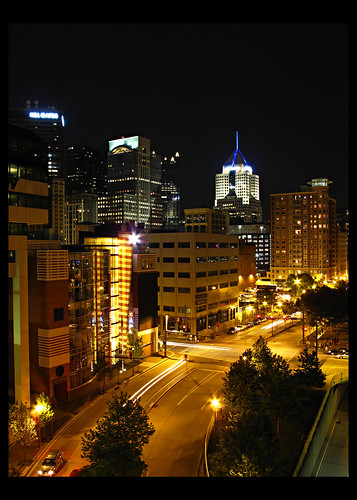
During my annual trip to Pittsburgh, I snapped this image to the left with my old compact champion, the then-new Canon G10. The compact-yet-rugged design was the object of my affection for some time, and although the ultimate image quality never deeply satisfied, the experience of shooting the camera was thrilling. Just a year later I made the unfortunate error of selling it, but at least the purchaser was my good Pittsburgian friend, Roman, who I trust to always put it to good use.

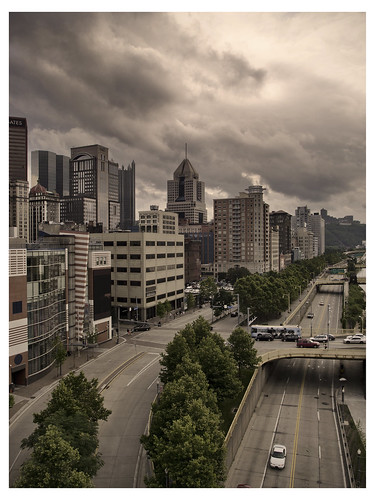
Let pass 2 years, and I am in Pittsburgh in late June, snapping an almost identical photo, but at a different time of day and with a VERY different result. Yet another image produced from a compact, but unlike the G10 the final image of the XZ-1 produced actual satisfaction and not subtle resentment. It stormed the entire time I was in the city, and something about stormy weather produces the most incredible skies. Two years back and I was still so enamored with night photography that I didn't know what a sky looked like.

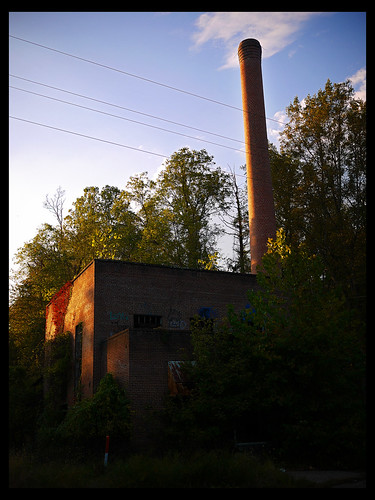
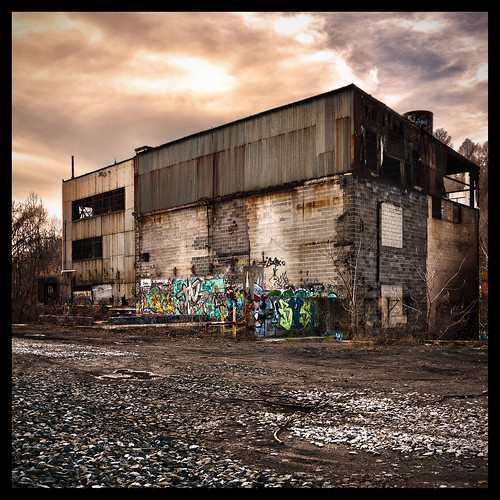
This image was the product of my first trip to a certain abandoned property to which I would return many times. After a long trek down a railway deep in the woods, around a few bends, over a bridge and through a dank, drippy tunnel, this boiler building was the first sign that the ultimate destination had finally been reached. Having walked for so long with nothing yet to show for it, I readily grabbed at my camera and entered a hazed snap shooting mode, photographing things around me but with little attention paid to delicate metering of alignment. Still, the building was the icon of the destination reached to me, and so I shared the photo with the appropriate community of culture fringe aficionados.

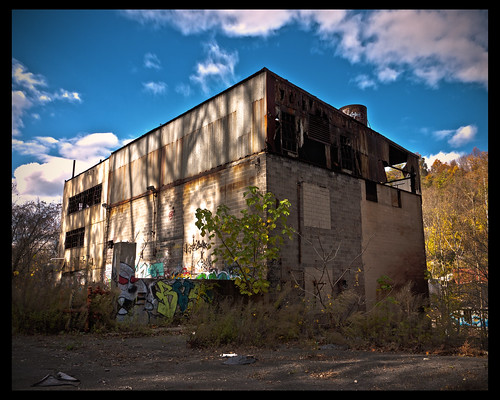
The next attempt was met with much greater success (or so I believe/feel/well hey, that's, like, just your opinion, man). All lines converged on a vanishing point in the center and above the image. Exposure was metered to evenly permeate the scene. And this image marked my first foray into the desaturated coloring that would define my images for some time. Granted, this image was taken in the same month as the original, and my habit to over-vignette hadn't quite been quelled, but this image certainly marks at least the beginning of several improvements rapidly made over the Winter months of 2010.

Sometime in October of last year I managed to acquire a wired shutter remote for my GF1 to allow for more stable image capture. Unfortunately, the flexibility of the camera's automated bracketing instead directed me to pursue the most loathed of faux artistic gimmicks, wide-spectrum HDR. It took no time before every "single" image was the hideous mashing of at least 7, typically with a dynamic range spanning from -2 2/3 to +2 2/3. The lack of contrast made the images horrible. Color was laughable and cartoonish. But my engineer goggles were glued to my eyes and somehow they passed as good images. This particular shot may be the worst offender.

Most folks countered their HDR disgust with judicious use of Photomatix. I, however, was cheap (and still am, come to think of it) and refused to invest money in something silly as a plug-in for Photoshop. Instead of taking the easy way out, I forced myself to learn how to make HDR look good with crude tools. Fine art painting with a drier lint brush, essentially. Shockingly, this image to the right represents the pinnacle of that pursuit. I relearned how to reintroduce measured contrast, adapted my desaturated style to subdue the pumped colors typical of HDR imaging and quickly learned that good HDR out of Photoshops integrated HDR tool required several HDR renderings be made, and each bracket-and-blended to generate an at all believably wide-dynamic-range image. Personally, I feel the image here to be a great success. A pain in the ass, but a great success.

Again, HDR obsession marked the processing of this image as well. It's not nearly as offensive as some of my early HDR attempts, but it's not interesting, either. Lack of contrast, a sacrifice to keep the sky looking evenly exposed, make the subject itself sag, especially given the kind of light that struck it that day. The image is poorly cropped, as well. Still, there is a measure of sentimentality associated with the subject. For several trips made to this location, I would come with my fellow photog, Ted, and we'd share a hookah in this little graffiti box (actually an elevator maintenance booth). Given the remote nature of the location, sunsets and their transition from twilight to complete dark were amazing to watch, and stargazing, a pastime I'd never indulged before due to the bright lights I'd grown accustomed to in city and suburban life, absorbed a good deal of our time and attention.

Just last week I revisited the locale and photographed the "fagbox" (as I came to call it on account of liberally applied "fag" tagging) mostly to see how it had changed since my last visit. Clearly, the graffiti took a bit of a nosedive in aesthetic. But from the compositional standpoint, the resultant image from last week's outing is many levels more appealing in the inherent aesthetic than the prior attempt. Most notably, I actually got closer and stopped worrying about exposing the sky is any specific way. The sky is not the subject, the box itself is. The idea is to make the viewer feel literally there, next to this edifice, in this environment of vandalism and decay. Color is pumped, but attractively so. It matches the presence the light and color had when actually on the scene. And the vignetting... well... okay, so I still amplify it a tad, but I also blame the lens for producing it as well. Not that it is necessarily bad for a lens to vignette, it's rather nice to have the corners darkened and centralize viewer focus where the subject really is. I'm not in the photography market for strictly true-to-life reproduction, after all.


All this nostalgia and looking back on my roots and the progress I've made really does make me far more excited about the future. I look forward to getting to review my own improvement again.

Wednesday, August 17, 2011

Hall of Mirrors

Reflections are kind of fun.Mirrored surfaces. They're only self portraits to a degree - the face is usually obscured by the very camera and lens taking the picture. Perhaps that makes them more accurate a self portrait than an otherwise staged shot? I'd like to think so.

This first shot to the right was taken in the Spring of 2010. Dennis was my roommate for a good while, and we shared a common group of friends that stuck together well after High School. Often times we'd meet up at Starbucks, catch up on our exploits since the last gathering, have some fun, drink some coffee... a good time. And, being the group shutterbug, I always had a camera in hand to snap away during the meeting. It just seemed like the right thing to be doing at such a low-key, friendly rendezvous. This shot in particular was made with the 35mm f/1.8 on my old Nikon D40x. I liked how the sun bled over the back of his hat with how this image was metered... man, do I miss that lens.

Just a couple weeks later and I snapped myself in the rear view mirror of my good friend Roman's car as he gave me a most appreciated one-man tour of Pittsburgh and its surrounding areas. I've always had a curious affinity for Pittsburgh - something about the people and how every class of citizen seems to blend in areas of occupation, the way its landscape transitions from rolling mountains to river valleys to plateaus, how commercial districts feature sunset overlooks of long dead industrial relics, it tickles both my dystopian musings and love of people adapted to melting-pot culture. Roman drove me around the city quite literally for days, showing me grand waterfalls, dilapidated buildings and industrial foundries, overlooks that simply don't exist in or anywhere near my home town, and I couldn't help but to snap away furiously the whole time. Pretty sure this particular image was taken while we were some ways north of the city, north of his home town, just before he brought me to Beaver Falls and I took some gorgeous waterfall photographs. I'd love to revisit the area with him some day. Again, the 35mm f/1.8 treated me well.

May of that same year I involved myself in a volunteer organization that had quickly made a large footprint in the charity world. Although the group had two avid photographers, they felt a need for a dedicated "camera guy", and so I was brought on board to both help with rest stop activities during charity marathons and biking events and snap photos of their exploits as appropriate (and they are indeed a photogenic group). My first working event with them was the 2010 MS Chesapeake Challenge, a biking fundraiser run annually by the Maryland MS Society. The entire event surrounded a college which had graciously volunteered its spaces and services in support of the event. Aside from providing the empty dorms as sleeping spaces to volunteers for the 3-day event, the cafeteria was also open in the mornings, fully staffed and serving absolutely delicious breakfast. Before diving into action setting up rest stops and serving wearied bikers, we all had a chance to converse and relax ourselves in the most classy of college meal spaces. I hadn't yet picked up my new GF1, and thus was still shooting the complete Nikon system I'd spent years assembling. If I could return to this point in time, kick myself with a studded steal-toe boot and stamp "IDIOT" on my past self's forehead, I would. The D40x body was old, and the GF1 certainly served me well in the kind of shooting I had an interest pursuing, but I should have never sacrificed one to attain the other. My photo-documentation of the achievements of the aforementioned volunteer group continues, but without the system I had previously assembled it has certainly become a degree harder. Granted, that was when trying to photograph their actions with the GF1 - perhaps it will be different with the E-P3, especially when equipped with my as-yet-needed VF-2 (or VF-3) and a good prime. Oh, and the XZ-1 to fill in all the gaps.

Have I mentioned I'm in love with the E-P3 + fast prime + XZ-1 combo yet?

Anyway, the above image was snapped while having breakfast with the other volunteers. I mentioned that the sunglasses on this gentleman's face made him look like the Unibomber, at which point I moved in to snap a shot as the person sitting beside me saw an opportunity to play keep-away with his glasses.

Immediately following the weekend with the volunteer group, a good friend of mine from Philadelphia happened to visit for an extended weekend stay. This fellow photographer, Ted, is largely responsible for my current photographic musings and general direction. While I had always dabbled in the photography of abandoned and vacant spaces, while I had always found them fascinating, I never felt a particularly strong sense of motivation to pursue those subjects. Given how much Ted and I enjoyed each others' company to begin with, we began to make excuses for our rendezvous by calling upon our mutual interest in photographing our mutually appreciated subject. Not that the excuse was ever needed, we managed to have a good time regardless of whether or not we opted to explore on any given day, but it was an opportunity for us to deepen our relationship. Very few people shared the kind of interests we shared, and even fewer were willing to indulge in those interests with others. Exercising our in-common hobby brought the bond to a brotherly level.

While exploring a certain hospital, a partially spherical mirror caught our attention. It was the kind used to see around corners, an asset to avoid collision. Whereas most had been smashed to sharp daggers of glass, this one remained quite in tact. It called for a photo. Still a Nikon guy at this point.

And so a giant chasm in my people-centric shooting began. My interest in sitting at Starbucks to enjoy coffee with friends waned. Asbestos was my new calling cologne. Mold and mud and rot coated my vision, and flakes of rust peeled off from my muse. I proceeded to make the first mistake commonly made by those who feel invigorated by something new - I indulged it too much. The muse was pursued too hard. Recklessly, and with wanton disregard for personal safety and consequence. And honestly, it's a phase of inspired artistic pursuit I'm still not entirely clear of. But unlike the shortsighted person of the year past, I'd at least like to think I've assembled some sort of logic, a standard of sense by which to judge my yet-made decisions and actions.

This image, the last I can seem to find from the past year's hall of mirrors, bears a hint of my past foolishness. Though perhaps not a focal point, focused or all that clear, I can see the indent and bloody scab of a rusted metal pipe to the head I endured just hours earlier. A sendoff from the power station I had been photographing that day. It required me to make a panicked trip to the hospital for a tetanus shot I'd neglected to get prior. Coincidentally enough, my grandfather was taken to the same hospital that very day, and instead of directly leaving I spent some time with family, some of which had already been there for quite some time. Though the general sum of focus was duly placed on my grandfather, the stained bandage on my forehead demanded explanation, and not one to lie I retold my earlier adventure in detail. That may be the point at which family began questioning my exceptionally fringe lifestyle.

On the way home hunger struck, and so I pulled into the Taco Bell of my hometown to pick up food for myself and my partner at home. The light was nice, a good blend of twilight and colors as they were projected from the drive-through signage. It begged a snap.


Something wonderful about photographs, no matter the medium and no matter the format, single still moments captured conjure a wealth of memories.

Tuesday, August 16, 2011

Wednesday Evening Revival

I said I'd get back on my feet eventually, didn't I? Oh, I didn't? Was just nay-saying and worrying about prolonged cold-feet syndrome? Well then, apologies.

Last week it was requested that I provide my photographic skills at work. On occasion it's necessary to photo-document various tasks and procedures, some of which involve VERY delicate macro work that requires a bit more technical knowledge and skill than the average Joe with the mode dial switched to "Auto". Part of the task to be documented also called for the use of some personally owned camera equipment, which fed me more than ample excuse to bring a change of clothes, the full bag of my camera equipment and a full tank of gas to turn the evening into a photo expedition after my workplace photographic duties were completed. The sun just seems to be at that perfect point in the sky during Summer months just as soon as work is over...

... Anyway, my day was well planned and laid out before I ever made it into the office. It's always a good day when my workplace calls upon me to employ my knowledge of photographic techniques. Although my title is certainly far from "Official Office Photographer", it's nice to be recognized as bearing that very specific skill set and thus be the go-to guy for any tasks that involve intensive imaging. If nothing else, it certainly makes the day more pleasant when it can be spent exercising the skills you already enjoy exercising.

I was already riding a euphoric high from a job well done by the time I left work. The sun was golden and bright and the light it cast on the world around me was the rich orange I wish could last forever. Not even obnoxious rush-hour traffic could deflate the swell of motivation boiling inside. It was a day to exercise artistic endeavors, to pursue dreams, and so I drove into that sun to chase the dream down.

My equipment roster started off rather lengthy at the beginning of the day but an instinct of purpose in my shooting drove the list to diminish. The Lumix 14mm f/2.5 sat comfortably on the E-P3 (oh, how I wish it was the 12mm f/2.0, though) with the kit 14-42mm f/3.5-5.6 in one roomy cargo pocket and the XZ-1 occupying the other. Looking back on the day, the 14-42mm could have even stayed behind. Something about primes, any shooting just seems to comfortably conform to the perspective they provide, nullifying any original interest in other focal lengths that may have existed. If ever such a curiosity about perspective struck hard enough, it seemed far more prudent to reach for the XZ-1 and snap an image than it did to swap lenses on the E-P3 (another reason I may very well be in love with that brilliant pairing). In keeping with the laziness/minimalist preparation, the tripod also stayed in the car.

The day simply played out with perfection. Things fell into place in a manner I nonsensically never thought they would, and my appreciation of the tool in-hand elevated by several degrees. For nearly a year I had been locked into a RAW workflow that I greatly resented for its time consumption and demand on my hard drive. Finally I could return to the comfortable, get-it-right-the-first-time manner of shooting that treated me so well when working with Nikon equipment. Unlike that antiquated gear, however, I was somehow able to conjure usable JPG images up to ISO 800, which simply did not happen before. Combined with the in-body stabilization amplifying the speed and steadiness of the f/2.5 lens I was using and even the need for a tripod disappeared. It was magic, genuine magic. A small camera with a small lens (stabilized in-body) and useful images up to ISO 800. The trifecta. All those dreams of a tripod-less future finally realized.

Odd, really, that it never dawned on me how incredibly useful in-body stabilization could be with fast primes. In the past I'd always considered that primes were already quick enough, that stabilizing them was frivolous ("If it's that dark, just use a tripod"). But look at what I shoot- scenes, static interiors, no motion to speak of. And given how off the beaten path my preferred locales are, it pays to travel light. Bringing a tripod to shoot scenes at base ISO and 1/2 second exposure used to be common practice, but now it seems silly with the advent of the body-stabilized wide prime and availability of mid-to-high range ISO territory to clean image capture. The Manfrotto may actually be relegated to strictly no-light applications, something I only ever considered possible with the high ISO range accessible with full-frame digital matched with a prime. I may not be able to stop motion, but if there is no movement to begin with what does it matter? So odd that it took the better part of 2 years and a body-stabilized camera in-hand to make me realize what a blatantly obvious advantage it is for shooting my typical subjects.

Aside from the great swell of appreciation for the tool in-hand being so well thought out, it was nice to revisit an old haunt all over again. The locale I chose to explore sees a good amount of traffic through the year. Whereas most find that this frequency of visitation desecrates the place, I find the offending vandalism gives it a sort of organic, ever changing charm and personality. Although the building and property are themselves a constant, unchanging aspect, the graffiti and state of disarray are lively and different from visit to visit. They are such vibrant parts of the greater structure that it can be shot differently depending on the manner in which the property is vandalized, making for a wonderfully amorphous subject to photograph. Seeing as my last visit was several months ago, the place kept me excited and giddy as I snapped away at old visages turned more awesome with time.

The entire experience was rather awesome, actually. Granted, the locale itself is considered "easy mode" in the circles in which I meddle, but after so much time "out of the fight", so much time spent longing to return to the muse... it finally happened. And much to my pleasure it doesn't seem to have been cheapened at all by any sense of unfamiliarity or even too much familiarity. I wasn't disappointed by boredom in the return to old subjects, nor was I stifled by an unfamiliar tool whose learning curve I still hadn't overcome. The tool, in both the standpoint of direct handling and of the ultimate image created, excelled to degrees I hadn't expected at all, and now leaves me with a marked confidence in regards to my future endeavors. And as for my stones to travel forgotten lands far less traveled by the typical passerby, I am elated to discover they are, in fact, still in tact.

Once again, I embrace the future.

Thursday, August 11, 2011

Figuring these new tools out...

It's a little crazy how much the ultimate quality of the image I'm able to produce is dependent upon so few factors.

This weekend I went out with my mother, grandmother and little sister to visit my late grandfather's grave. Being that our intent was to straighten up the plot and lay down fresh flowers, it seemed prudent to bring a camera. Some people find the concept of photographing a funeral or grave site profane or taboo, but my family is intuitive enough to understand my method of grieving involves the lens. Photographs of the gravestone and arrangement were certainly taken, but those are private.

Not private, however, are the photos I can't help but take of my little sister. Like most kids her age, she's a spitfire, a well of drama and overflowing personality, and she makes for some awesome photographs. I took a few of her at random points, some in the car, some over dinner. Some strange thought crossed my mind earlier that day and possessed me into bringing both the XZ-1 and E-P3. While snapping pictures of my sister in the back of the car with the E-P3, I realized she was reticent to hold still for a photo and thus switched to the XZ-1 for sake of its faster lens. Once home and able to review the images in greater detail, something stunned me. I couldn't tell the damn difference from one photo to the other.

Now, granted, the images were not shot with the same lens, parameters were very different and one was a 10MP image whereas the other was 12MP (but since when did anything less than a 400% difference in MP ever matter). From a technical standpoint they were very different images, but coming from a purely aesthetic standpoint, paying attention to the little factors that matter such as color, tone, gradation, the commonly overlooked elements that are only not the subject of camera review websites and forums because they are impossible to quantify, the images looked as if they were produced by the same camera. Both images were sharp, with perfectly balanced detail retention, held great skin tone, well measured warmth, little to nothing stood them apart.

I'm sure such a discovery would offend some consumers, feeling that the E-P3 is a rip-off of a tool if a tiny, boxy little point-and-shoot could rival it in any capacity. Personally, this realization that my compact can give me comparable quality to my EVIL tool has me elated. What working photographer is ever satisfied without a backup system of some kind to fill the gaps present when the primary tool isn't up to the task at hand? When time is a critical element of a shoot and there's no time to switch between a telephoto prime to a wide-angle lens, what does one reach for? And if the tragic scenario should occur in which the primary tool, for whatever reason, becomes an expensive paperweight, what does that working man reach for?

A backup is a critical tool in and of itself. Most photographers use a duplicate camera as a backup so that lenses may be paired between the two, but I find the compact backup much more useful, especially when it demonstrates image quality to the extent of the XZ-1. The thing gives me an absolutely incredible 28-112mm coverage equivalency, and the f/1.8-2.5 aperture spread allows it to de-focus a background much in the same capacity as any kit f/3.5-5.6 zoom. Given the subject matter I prefer to shoot (interiors and landscape) having the light capture of f/1.8 and the depth of field equivalent of f/3.5 is more than ideal. And like most compacts, the macro capabilities of the camera are very competitive with equivalent macro lenses, and for those things that hold still and don't require much working distance, the switch-able "Super Macro" mode allows the camera lens to nearly be touching the subject. Put simply, the XZ-1's feature set makes it not only an ideal backup but an addition of versatility to my system.

Although the photos have yet to be processed and posted, I put this XZ-1/E-P3 duo to the test yesterday to put it to working practice. Understanding the nature of the images I'd be capturing beforehand, I simply attached the Lumix 14mm f/2.5 to the E-P3 and pocketed the XZ-1, a very light load. While I found myself shooting the E-P3 mostly for the wide-angle and edge on image quality at higher ISOs, I much more than once slung it over my shoulder, palmed the XZ-1 and fired off some incredibly clean macro shots of various items around my locale. Both tools saw nearly equal use, and the ease of switching between cameras made the transition almost transparent. It was a powerful combo, and a very enjoyable one to work with.

Can't wait to review the images (hopefully today) and share them, as well as yesterday's adventure.