Friday, April 6, 2012

Uprooting Syndrome

Life in general has been on an all too lasting holding pattern as of late. Last month I signed the lease to a new apartment, and while items were trickling over into the new space the entire time, it has been in the past week that the vast majority of major item moves have taken place. As it stands, the new apartment is more or less together with nearly all the "keepers" from the old space, but with that said, the old space still needs to be emptied. As nice and obvious an "upgrade" as the new apartment is, the transition is bittersweet - after 4 years in the former residence, memories, habits, a solid history had formed in and around it, the likes of which it will naturally take some time to form in the new apartment. Much as I love the new place, it just won't have that home feeling until I've been there long enough to built a new set of patterns, write a new history. Ah, the impact of sweeping transition.

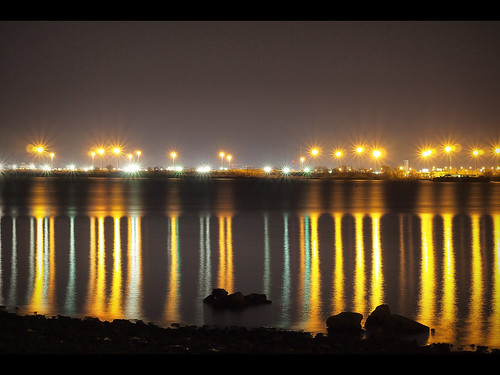
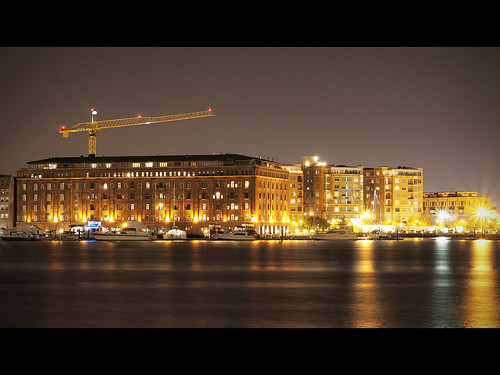
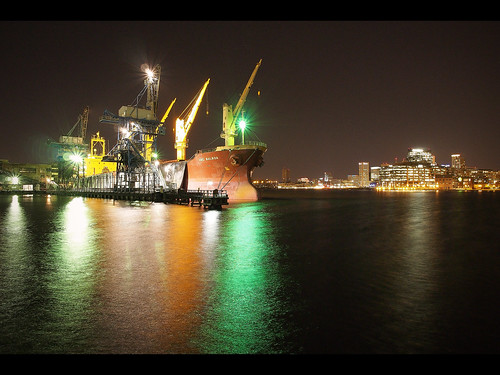
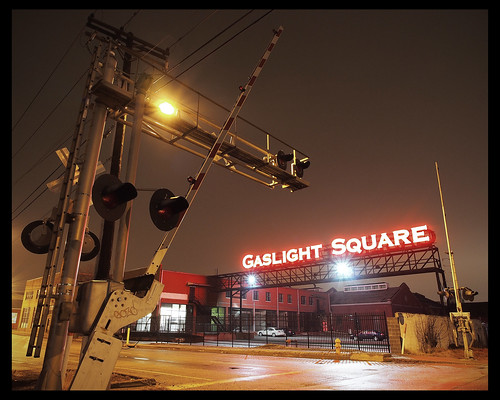
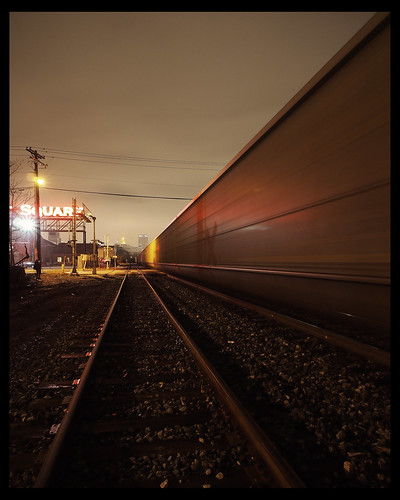
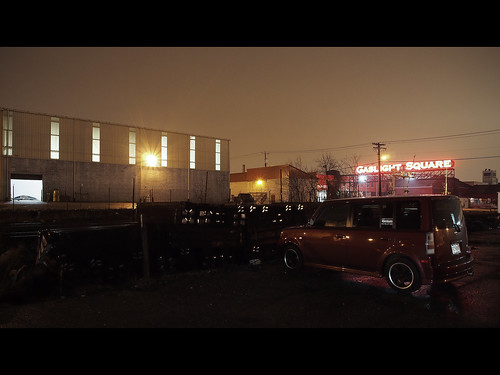
The only photography I've managed to engage in during the past couple weeks has been some shooting in Baltimore, at the inlet of the Inner Harbor. Night shooting, the classic stuff I learned the art of photography on to begin with. Learning some niche issues that make the E-P3 a bit tricky to use when shooting at night, but learning it well enough. Still in love with the wildly punchy but somehow balanced colors it produces in i-Enhance mode. To remove one annoying little handicap to my post-process, I invested in a new monitor last night, a 23" LED with excellent tweak-ability and bundled calibration software, perfect for ensuring solid photo editing. It's nice to not be left squinting at the screen anymore to edit photos and be a slave to off-even zoom levels. It may not affect ultimate image quality, but it will certainly make the experience of post-processing less cumbersome and annoying on my end.

Another off-usual tidbit from last week, I visited a therapist for the first time in many years. At the encouragement of a friend (though, really, multiple friends), I sought professional counseling to get to the core of a multifaceted and deep seated disquieted demeanor I just can't quite seem to shake. I've been more and more prone, in recent years, to essentially consume stimulus much as one consumes media such as TV or movies, and much like those who watch too much TV or waste too much time watching movies or playing video games I've reached a point where no matter what my goal, the hobby in practice, whatever I may be working towards or in pursuit of, I am never satisfied by the ultimate outcome. Not disappointed at the end result, but disappointed that it is a completed goal. If not on a constant journey, a non-stop march to complete some objective, I quickly grow bored and stir crazy until the next goal is presented. Effectively, I am binging on work because I'm never content with the result no matter how positive. After my first session last week, it was suggested I read up on and engage in the practice of meditation to slowly bring myself to contentedness with doing nothing, and while I would like to try it the first step demands a location that is relaxing, sacred, generally non-stressful, and because I am in a new place that isn't even entirely together there is nowhere at home that qualifies.

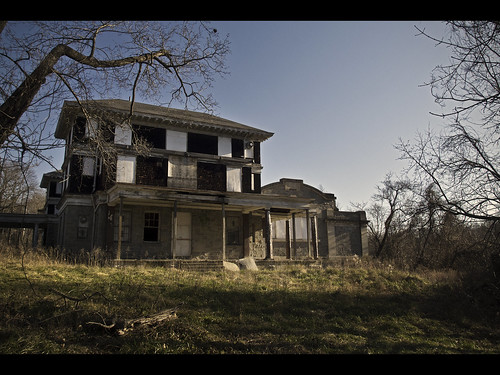
Best I could think of was perhaps driving out to one of my abandoned sanctuaries and practicing meditation there, which I'm fairly confident would work, but that line of thinking brought me to a deeper point of understanding about how I work mentally. I haven't explored solo in quite some time, usually bringing along the safety net of a friend such as Kyle or with a trustworthy group. From a safety standpoint, such a practice is best, but I thought further about how I felt while exploring on my own, with no safety net. Mental wellness meditation involves a strong emphasis on body awareness, demanding central focus on breathing, where the body occupies the space around it, generally a sense of where you are, strictly locking the mind in the time frame of the present. While exploring in groups, my mind has always been muddied by the influence of those people, be it self-conscious thinking of their perceptions, the influence of their photographing approach on my own, any number of subtle, often overlooked ways in which we interact with each other simply by being in close proximity. Alone, however, there is no better way to describe the experience than the most firmly rooted in the present and the most keenly focused and aware of myself, my body, my presence. Concern for Facebook status updates, what I'm eating for dinner, how much gas I have left in the tank, what groceries I need, whether or not I cleaned the stove, none of it ever entered the picture during my solo explores of late 2010 and early 2011. Everything was strictly in the moment, and the only elements that mattered were what were directly available to the senses. In essence, those solo explores were like meditation all their own. I'm thinking perhaps I should engage in the practice of it again to reset that scope of clarity they provided before. If I can learn to function strictly in the moment during an explore, certainly I can bring it with me into my normal day-in, day-out.

Hopefully this weekend the apartment transition will be complete. Then, finally, I will be able to return to a more normal span of activities. My hands miss holding the camera.

Thursday, March 29, 2012

Skylines and Mountainsides

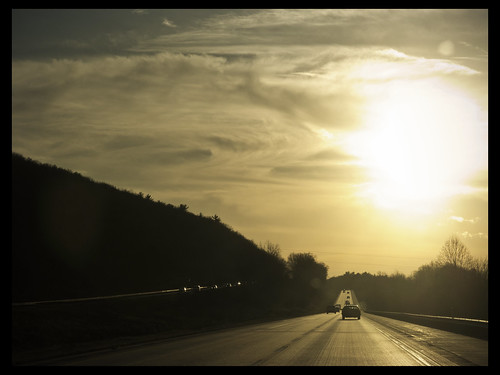
On this day last week I was roadway bound for the region around Shenandoah Valley, specifically gunning for Skyline Drive. If you haven't heard of it, you should have. It's a very touristy locale, but still manages to offer the kinds of stunning vistas you'd think only hardened mountain climbers should ever get the opportunity to see. I'd been there once before in 2010 with a good friend who held similar interests in the photographic sense as myself. Our time there 2 years ago was the stuff of magic. While last week's excursion was certainly not nearly as long a trip, it was still a time of heavy introspection and abstract worldly appreciation. One of those rare opportunities to step back from the game our modern world has made of our day to day existence and contemplate the stuff of existentialism, the stuff that really matters.

Driving down last week proved to be one of those quirky little adventures all its own. The main point of amusement was a hiccup in our chosen GPS device. Utilizing my tablet for all directions and other such location-related needs, we (Kyle tagged along on this trip) managed to make it a majority of the way without a hitch until the signal the tablet received from the cell towers dropped to nil. Suddenly the satellite was grossly off our actual location, so turns, landmarks, roads, everything was askew just enough to throw us that critical little bit off course. Frustrated, a quick stop at a lovely little Italian eatery in the land of Middle-of-Nowhere was just the recharge needed, and with our bearings re-synched we managed to make it to the place we'd chosen to stay for the night. And oh what a place it was.

Two thousand feet up on the undeveloped side of the Pocosan Mountain, hidden like a treasure up nasty, aggressive gravel mountain roads, a local conservationist, naturalist, farmer and all around green thumb had set up a rather large yurt on one of the cliff sides of his 60 acre mountain top property and rented it out to those interested and willing to brave the trek to reach it. He happened to have it listed on the website of the company that contracted me to shoot their listed rental properties, and for the minimal fee he was charging for its use it would have been an insult to myself to not have taken up the offer. Kyle and I aimed to stay there just for the night, my intent being to photograph the mountainside views as tenaciously as possible, but with Kyle's influence the vacation quickly turned from self-prescribed work to an actual, legitimate instance of rest and relaxation. What with the host's home grown meals served to us in the evening and for breakfast the following morning, a hot tub with an amazing sunset view and amazing views in general, it was hard to want to do much else than sit, let stress dissolve and take in the unique sounds of such an isolated area. An actual vacation, fancy that.

The following morning we set off to wander the winding roads of Skyline Drive. Again, while my intent had been to stop and photograph the overlooks aggressively, that simply isn't what happened. We did stop to take in several overlooks, but most of my attention that day was directed to the simple pleasure of aggressive driving, tackling the limited roadways as hard and as fast as possible. I don't think I have ever smelled brakes cooking so repulsively. Each stop at an overlook, though providing an opportunity to take photographs, was ultimately more an opportunity to let my brakes cool off and just generally give the car a chance to breath after the demands I placed on it for miles and miles and miles. It was a fun time, regardless, and Kyle wasn't terrified at all sitting shotgun through my irresponsible maneuvering. Was rather nice to have someone riding passenger who at least understood the method behind the madness of some of the more aggressive handling techniques I employed. 67 miles and 40 minutes later, we were in Front Royal, and even though our adventure hadn't lasted too long, we were both oddly eager to get home.

Unfortunately, the haze over the Blue Ridge Mountains was still heavy. I had hoped the haze would be more subdued in the Spring (my trip in 2010 was in the Summer and haze was atrocious). Ultimately, this means a Fall trip will be required as I am determined to photograph multiple North American States in a single image, and the nearly 4000 foot peaks of some of the mountains of Blue Ridge are some of the only places such a task can be accomplished. Just a quirky personal goal. But I will most definitely be looking forward to staying in the yurt once again.

It's also becoming more and more of a priority to me to shoot such scenes in lower light, either at nightfall or twilight states. They just speak to me more when photographed at those times. Well lit scenes are just so bland anymore.

Tonight I will possibly be shooting with the crew of local urban exploration masters I linked up with in January, but all will largely depend on events at home - I am in the middle of moving into a new apartment and alas the air mattress I've been sleeping on for nearly a year decided to pop last night. Oh well... cest la vie.

Wednesday, March 28, 2012

Abandoning the Status Quo

It's been a long while since I've made a post on this forum. Peculiar, really - as much as I have done, as many things as I have accomplished in just the (nearly) 2 months since my last entry here, somehow I feel like I have accomplished remarkably little of note. Or perhaps that's simply a rise in my sense of personal doubt that anyone actually cares what I am doing (and let's face it, why should they)? Not sure... but looking back over the past two months... dear lord, my world has been shaken.

Let's start with the business aspect of photography (since I like to pretend this blog is somehow business related in any respect at all). Early in February (but after my last post, obviously) I received a message from a photography department liaison for a certain vacation/travel real estate rental service that has blown up to something quite big over the past few years. At the core, their business model is decidedly "European" - when people have guest spaces they aim to rent out to short term travelers who would rather opt into a private space than a hotel, this company handles the money between them as well as functions as a sort of background checking buffer to ensure hosts and guests are trustworthy individuals. A simple and rather novel approach to rental properties, streamlining the booking process and doing well to alleviate concerns one might have when allowing strangers into their home (and vice versa). While every listing tends to have at least some photos snapped by the property owners themselves, this company contracts freelance photographers in various areas and distributes locations in need of more professional presentation. Effectively real estate photography.

Anywho, this liaison approached me with a very direct offer - not verbatim, but in generally the same words, she proposed to me "You take such fantastic photographs of the interiors of these abandoned structures, how would you like to be paid to take photographs of some not so abandoned interiors?". Long story short, I most enthusiastically accepted the offer made - now I am officially employed as a photographer! To date I have conducted well over a dozen shoots, for which I have been compensated quite graciously. Finally, after years of persistence and missed chances, I am operating in an industry I actually reserve some strong passion for. Good times, for sure.

Partially related to my engagement in such a business form of photography, my editing methods have also undergone tremendous adjustment. The standard by which everyone in the industry swears as far as post-processing goes is Photoshop. Well, Photoshop or Lightroom. An Adobe product. The packaged RAW editors delivered with cameras very often fall to the wayside, neglected and unappreciated.

Following the standard, I utilized Photoshop to process the RAWs from my first photoshoot for the company that contracted me. And much to my alarm, my submissions were rejected for not conforming to a certain style and expectation of image fidelity I simply didn't know how to achieve with Adobe Camera RAW. I fooled with the RAW for hours in ACR and could never manage a clean looking image that would pass the review gate, and as such I feared my chance at continued employment with this company was in dire jeopardy. Desperate, I traveled off the beaten path - I couldn't return to reshoot the scene using JPG processing in-camera (as I suspected the i-Enhance color mode with my manual adjustments would have been the golden formula the company was looking for), so I installed the Olympus Viewer 2 software offered along with the purchase of the camera. I knew that RAW editor would effectively allow the application of color profiles offered in-camera, just with much more in-depth tweaking available. While worried the clarity of the image would not be up to par with the detail retained by ACR conversion, I dove in regardless, out of options and desperate to submit a product that would meet the company's approval.

Not even 20 minutes later I had a solid bank of 15 or so images I knew would pass through the acceptance gates with no problem. More importantly, the next few hours I spent experimenting, reprocessing images I'd shot months ago in RAW, because dear lord Viewer 2 managed to produce a kind of tonality and color fidelity I would never in my life ever learn to achieve in Adobe Camera RAW. And to this day, my post process has effectively abandoned Photoshop entirely - Viewer 2 is that good.

Before, my process never affected the RAW file in ACR that much before it was fully rendered and dumped into Photoshop for layered editing. As such, the color profile of each image was an identically bland natural tone that depended entirely upon heavy adjustment layers to manipulate into anything original or artistic in aesthetic. I'd doted before on Olympus' magnificent JPG engine in-camera, but never really came to the understanding that the same color fidelity could be achieved with its own RAW development software. My only exposure to manufacturer RAW development before Viewer 2 had been Nikon's NEX software, which (as any photographer will tell you) was an atrocious failure of function. That first impression left a stigma that made me afraid to travel outside of Adobe for imaging software. Just as Olympus has a monopoly on ingenious JPG rendering, they similarly have the monopoly on supremely functional and genuinely useful RAW development software packaged with their cameras. No need to spend $900 on the Adobe suite when the camera you already spent $900 on can render an image just as well, if not better, with less effort required on the end of the user.

It dumbfounds me that Olympus isn't higher up on the photography tool popularity charts. They are the only manufacturer I have maintained a system from that actually has the entire package together to maximize the capabilities of the end user of their equipment. Their systems are open and modular, with both in-house support and that of many third party manufacturers, their products come packaged with functional, competent software so the end user isn't required to look elsewhere for optimal image rendering capabilities, they even provide for offsite storage of image files and the bandwidth to carry the load of image sharing and distribution. The system couldn't be more complete, from both a software and hardware end. It doesn't just stop at the capabilities of the camera, it runs over into excellent customer support, quality warranties and product repair, community and open sharing of information between end users - I would call it the Apple of digital cameras, even though I bear a strong contempt for Apple (which isn't to say I respect the amazing product and user support they provide). Digital imaging is so inundated with obsession over the hardware capabilities of its tools, a shame more people don't take the time to step back, look at the greater picture. I'm certain, if they did, Olympus would never have suffered the scare of 3 years ago when they very nearly dipped into irrelevance to the market.

Aside from those two very landmark points... well, let's see... I'm sure I've been up to other things too. My protege, Kyle, and I spent one weekend more or less binging or urban explores. His presence during an explore is a welcome thing - he manages to challenge my usual hesitations and boundaries of risk in ways that encourage the will to conquer them, not the easiest balance of provocation and empathy to exercise. We also took a trip into the Shenandoah Valley region off Skyline Drive for some natural landscapes, but alas, the Blue Ridge Mountains lived up to their name even this early in the year. They definitely demand a Spring-centric shoot to avoid their usual mask of haze. My backlog of personal images has gotten rather tremendous, what with photos from working shoots often taking precedence. However, with my log of working photoshoots taking a bit of a needed lull, I hope to present more of my most recent material this week.

So much in so little time. And so strange that is seems like the complete opposite to me... I really should learn how to relax a bit more.

Thursday, February 2, 2012

More Shooting Less Talking

I'm pretty sure I've done more shooting in the first month of this year than I did for the whole first quarter (the only relevant part) of last year.

Having built good rapport with some key people who abide by the same discipline of photographic interest as myself, I've adopted a spot in the ranks of a very active and very enjoyable troupe of photographers with a penchant for adventure. I'll skip the verbose theatrics and simply state that they are THE urban explorers of the greater Baltimore area. While I've run across many who explore in the region, these folks would be the first that have clearly taken their discipline to the next level, and I am many time thankful to be welcome among their ranks.

Possibly the most interesting, most telling indicator of this mutually appreciated sense of accomplishment is the general lack of urban exploration we ever necessarily feel bothered/compelled to do. Our meetings have taken on a pretty standard formula at this point - we meet at a predetermined location, usually somewhere public and relatively low key, and although our initial intent may be to venture elsewhere and explore, our track record has us more frequently sticking to that initial location, chatting for hours about our adventures, our feats, our achievements, the stories, the memories that are the greatest treasures we own, maybe wandering a bit off the beaten path from where we started, usually with a couple beers in hand (or in stomach), and after hours of regaling each other with our privately treasured tales grand idiocy for sake of getting "that image", we part ways and look forward to meeting the next week. There may or may not be some happenstance train hopping that takes place in between.

Although I've only managed to attend a small number of officially organized events thus far, the group has a solid track record which leads me to expect nothing but good things from future meets. These are the guys who actually manage to get permission by factor of expressing their legitimacy. The ones who understand that food is the universal language and that beer is the universal feelgood.


So yeah. I aim to stick by these guys for a while. Now onto photography  things.


During these meetups with the new photography/adventuring troupe, I've been relearning the art of night shooting all over again. My process in post used for low light but still daylight images simply did not work for night shooting whatsoever, bringing forward far too much noise of the unattractive, blotchy color kind. It took some time and a lot of play to figure out how to achieve the look I was shooting for without butchering the quality of the image, but I'm pretty sure I'm at that point now. It simply required two leaps of faith - the abandonment of RAW and trust in native red channel fidelity. Basically, a step back to my former, 2004 self's style of shooting with just a little bit of an edge from years of learning and experience.

Yet again, Olympus' JPG engine continues to impress and make it very hard to justify the hard drive space that would otherwise be consumed by RAW. Against all logic or understanding of the engineering behind imaging technology, I'm simply getting cleaner, equally tweak-able files out of calibrated JPG files than with RAW. Some of this has to come down to a lack of responsible RAW processing on my part, but at the same time I managed to manipulate RAW just fine back in my GF1 days and that RAW fidelity is trumped wholly by JPG resiliency from the E-P3. Sorry, engineers/fauxtogs/GWCs, Olympus got JPG right.


Using the 12mm f/2.0 has been a joy as well. Barring what everyone already knows about the lens (it's sharp as hell, small, light, well built and just all around sexy), the lens genuinely provides a very critical ease to manual focusing with its pumping focus ring. I wrote off the stepped, dampened, marked focus ring as a gimmick to cater to older photographers (fly-by-wire manual focusing has always served me just fine on MFT) but with all the night shooting I've been doing its function has been a boon to ease. Even an f/2.0 lens will struggle to acquire auto focus in abysmally low light, but with the dampened focus ring set to a predetermined infinity mark on the focus scale, a position is literally "remembers" when you pump it in and out of that forced manual focus mode, any challenging focus situation is easily resolved (or simply bypassed entirely) by pumping the lens back. It's just plain awesome. And at f/8.0, literally everything is in crisp focus, not to mention the star bursts over sharp points of light are looking gorgeous. I could easily get back into night shooting with such a smart tool at my disposal. Such a simple thing, but easily makes the lens worth its comparatively high price tag.


Unfortunately, during one of these night shoots with the new group, I lost my XZ-1 to tragic circumstance. To keep the story short and sweet an abandoned train car was involved, as was beer and (therefore) possibly some mild inebriation. Olympus has come through for me in this matter (they seem to be treating me damn well in general, really) and have fixed the thing for free. It's currently en route back to me so that I may get back out there and put it to use. I've missed not having my little pocket rocket point and shoot on me at all times. Even if I never took many images from it to post, it certainly helped me to scratch that incessant shutterbug itch on a moment's notice when needed. The tripod aforementioned camera was mounted on is very much dead, however, and while I wait for my budget to permit a replacement I'm stuck using an atrocious, plastic Dynex unit from Best Buy. For the longest time I never understood the point of spending triple digits on tripods, now, having been spoiled by a well made tripod and being forced to regress to inferior tools, I couldn't be more excited to drop a C-note on a Manfrotto or Slik replacement.


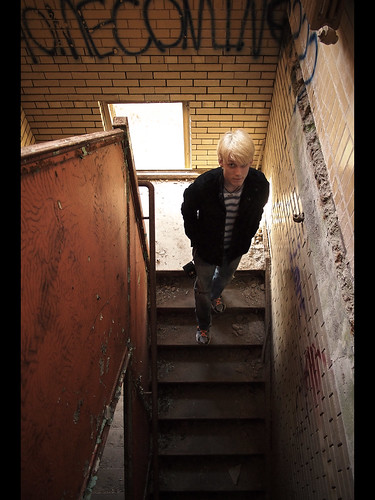
Tonight, Kyle, the young fellow I randomly photographed a couple months back and somehow managed to engage in a strong, lasting friendship, is due to come over and let me experiment with my shoddy, poor-man's budget studio setup. I really am glad I've made good friends with Kyle... not only is he a good friend, but he's a reliable exploring partner and an engaging model for studio work. And when the camera is put down, he's still down for random movies, hookah, wine and pasta dinner. The perfect partner for any photog.


He's not even judgmental about being placed in front of a wrinkly bed sheet thumb tacked to a wall and a pair of Walmart special tin shop lights with 100 watt halogens in them. What a guy!

Thursday, January 19, 2012

Doting on the XZ-1

Immediately after my accident and the month and a half or so into the recovery phase that logically followed, there was one dominant priority at the forefront of my mind. Get a camera. On a personal level, it was a rather telling thing that the first thing that I felt compelled to address after such a traumatic event was the acquisition of a replacement imaging tool. Really solidified the importance photography has in my day to day life. The funds weren't present for immediate investment in a replacement system, what with all the medical billing shenanigans going on at the time, so I looked at the market of pro-sumer compacts that had always appealed to my inner minimalist and I dropped the necessary half a C-note on the best of the best available, Olympus' flagship compact, the XZ-1.

It's a tiny little thing. Pocket-able, unlike the Canon G10 which I used avidly maybe a year or so before. In the hand, it just doesn't feel like all that impressive of an instrument, more akin to your grandmother's Kodak branded point-and-shoot plastic box than a professionally oriented tool. But I'll be damned if the thing doesn't take occasion to put even my larger format systems to shame. It has some undeniable strengths.

More and more I find myself compelled to put the unique imaging latitude of the XZ-1 to use in favor of the E-P3 system, especially when the subject of interest in outdoors and in waning light. I couldn't possibly begin to express why it is able to do so, but the RAW files it produces have an absolutely magic quality to them. Despite the diminutive sensor backing it, highlights have a wonderful shoulder to them in their transition into middle tones (which I admittedly screw up almost habitually by cranking the recovery slider up to 100, an unfortunate instinct). The dynamic range of which the sensor is sensitive to is unreasonable broad for such tiny piece of silicon, very readily bringing out much detail in shadowed areas without the expected sacrifice of highlight retention typical of sensors of its size. Whatever programming mastery backs the unit is as wonderful as it is perfect. Colors, noise (up to ISO 200 anyway), dynamic range, they all simply... impress. And they do so with a very analog, candid, expired film look and feel that resonates deep with me as I'm often reticent to return to film these days. To have a sensor that produces images very much akin to the look of old, washed out film (but with enough digital pizazz to come across as clean and rendered with intent rather than happy chance) is like a dream come true.

My fondness of the XZ-1 is likely rooted with my introduction to photography in the thought-out, less casual sense. Sure, I'd snapped a few with old film cameras before, gone through my share of film for fun, but it wasn't until getting my hands on that first Kodak DCS digital camera, that 1 megapixel clunky behemoth that ushered in the digital era of imaging, that I ever took photography to heart as a serious art form. Up to then I was all about traditional media, charcoal, pen, colored pencils, occasionally paint. Perhaps the reason why mirrorless cameras resonate with me in general is based on how I learned to compose and photograph in the beginning. The viewfinder of that old Kodak was miserable and tiny, useless for most applications and especially in low light. It became a much more comfortable and second nature habit to use the live view of the larger back screen to compose the photograph, much like I would visualize a subject for prospective charcoal sketch or painting. It just made more sense to work in that way. Only years later would I acquire my first DSLR and learn what a viewfinder could actually be, but I still felt more comfortable composing on a screen than via pentaprism. Old habits die hard, I suppose. About the only thing the pentaprism permitted over composition on a screen was an abstract personal connection to the subject, something that only ever had poignant affect when photographing people, but that's a whole other subject entirely. Point being, I feel more comfortable composing on a large screen, at arms length, so to speak, because it hearkens back to the way I would visualize before approaching art in more traditional media.

It has its limitations. And I like that. The limits are the challenge the tool presents the user, and while most people depict those as shortcomings of a lesser camera, I take them on as personal challenges against which to combat, to force the strongest possible image and maybe even break that glass ceiling. That is perhaps what I feel myself doing every time I use the XZ-1 in place of its (at least technically) more capable older brother. Compacts aren't supposed to present a shoulder to tone curves. Compacts aren't supposed to be so damn sharp (and let me tell you, the Zuiko glass in front of that tiny sensor out-resolves it by several orders of magnitude, so much so that wide open it's unreasonably sharp). Compacts aren't supposed to present a width breadth of tonal range, allowing detail retention in shadows and highlights alike. They simply aren't designed with that intent in mind. Compacts are made for the casual shooter, or as a shoddy backup, not ever with the intent of being a dedicated, front line tool in the field. But dammit, the XZ-1 stands out among the crowd of premium compacts as being uniquely capable of standing on its own as a primary shooter, not a backup. Small as it may be, it has the core control functions demanded of any pro. The only way in which it doesn't stand up to serious field work is in the lack of impression it makes on clients (which is very much a similar problem experienced with even its older brother in the mirrorless camera markets).

Tonight there is a certain night shooting extravaganza planned to occur. While tempted to bring along the E-P3 and its 12mm f/2.0, I had a hunch that it would not be the preferred item for the venue chosen. I've always adhered to a minimalist approach to photography ventures, and tonight will be a venture most minimal. Just 2 pieces of equipment - the XZ-1 and a tripod. Like old times when I would wander out onto the streets of my home town at night, studying light and shadow, reacting to it, stopping for the exposure and then moving on. A truly minimalist, kneejerk approach. I'm looking forward to it. That little Zuiko lens' aperture produces some sexy fine pointed sunstars, after all.

Wednesday, January 18, 2012

SOPA/PIPA Awareness

I'm usually one not to mingle business, pleasure and politics. Trifecta as they are for some, the directly interfere with each other most of the time for me. Particularly the politics one, it just doesn't seem to be trustworthy to play with anybody.

As some of you may have already realized, many websites today are either outright blocked or minimal in content in a form of active protest today against the SOPA/PIPA acts dancing through Congress riding on the backs of heavy investment by the entertainment industry. While at a shallow level they are bills intended to curb piracy, they are worded with loose enough language to quite literally destroy the freely growing culture that has defined the internet up to this point, and if history is any teacher it shouldn't be long before that loose language becomes the slippery slope down which the internet falls. We could very quickly have an internet much akin to that which China experiences, limited and tightly controlled, only instead of censored by government standards we would be at the whim of frivolous copyright infringement suits laid upon us by the largest of entertainment brands. Fair Use would quickly be a thing of the past, for who has the financial power to compete against the limitless funds at which we'd be mercilessly thrown against?

Please, take the time to do the research if you haven't already. And if you have, then take the time to contact your Senator, your Congressman, their secretaries, the President, someone, anyone with an inkling of power of this issue. This bill cannot pass into law, lest the internet be reduced to little more than commercialized radio or the shell of corporate cable TV. Keep the internet free and it stays the wealth of knowledge whereby anyone can learn about anything. Keep words free. Keep knowledge free. Keep creativity free. Keep the dream alive.

http://www.protectinnovation.com/

Tuesday, January 17, 2012

System Disparity

Oh hello there, Kneejerk Imagery blog, I forgot you existed for a while.

Pardon my hiatus, but the period between my last posting and now was filled with rampant, indiscriminate photography in practice, and my return to posting has only occurred due to the tire-locking brakes put on my creative momentum due to a particularly persistent (and immensely annoying) cold. So please, allow me to present you with an update on the status of Kneejerk and its exploits in this (thus far) most glorious of New Years.

Perhaps by accident (but much more likely by surreptitious intent), I've acquired a new partner in my forays into the detritus of discarded Western architecture. The repeat subject of candid portraits I met rather late into last year, Kyle, has taken a particularly strong interest in the scenic subjects predominantly featured in my online galleries, enough to express interest in visiting them in person to satisfy his curious appetite. Normally I am one to keep these locations private, but having developed a solid working relationship with Kyle and having discussed in great detail his core motivations for wanting to visit there derelict locales, I saw an opportunity to further nurture the relationship into a collaborative effort in the artistic. Having engaged in multiple "explores" with him at this point, he may very well amount to one of the best partners in crime I'm had.

Our first outing he brought along a camera of his own, a solid Nikon superzoom, but given that his interest lay less in the photography and more in the simple pleasures of exploring the unseen, he often asked if I would like to put his camera to use. Subsequent expeditions he traveled sans camera completely, opting instead to bolster his assortment of equipments to include many tools that would make even the most hardened explorer drool with jealousy. With this local and very focused compatriot available to coordinate with for expeditions, I found myself willing to take far more risks with locations, expanding from my countryside locales deeper and deeper into the less pleasant areas of the inner city. While my guard is down in the middle of composing a photograph, Kyle manages to be ever vigilant, often volunteering himself to be the point man of the expedition, clearing areas prior to my entry. An appreciated service. I owe him more than he knows.

Interestingly enough, he and I have even encountered a couple of the worst case scenarios for explorers such as ourselves, what with flustered, shotgun toting property owners and thumping helicopters having been obstacles in the way of our benign objectives. In all such instances, his conduct has been most impressive - without a word needing to be uttered, he knew not to panic, and as if on some telepathic wavelength we operated as necessary in perfect unison to avoid unfortunate and dire consequences in pursuit of high art. Suffice to say he is a long awaited boon. I am proud to have him accompanying me on our little adventures.

What with the recent and successful pairing with Kyle on so many explores, I felt encouraged to escape the hermit shell of my former modus operandi of solo exploration and actually latched onto the reigns of the urban exploration community at large. Though my New Years Eve saw early conclusion in a 10pm bedtime, the first day of 2012 was spent with a couple of the community's more hardcore iconic figures on a day-long road trip to a neighboring city and great trio of successful inner city explores. An absolutely fantastic time, to say the least.

The third of the New Year's Day explores would stand as a personal landmark occasion on a private measure. For a long time I've harbored an irrational fear of heights. It has often left several choice opportunities for impacting images unfulfilled, such simple obstacles as a ladder or moderate climb over a ledge face standing as my ultimate undoing. On New Year's Day, the third explore of the group was a certain high rise building of ill condition. Though I have explored many a building of notably sour condition, this one in particular very much took the cake for being the superior deathtrap. It was a structural nightmare, with a majority of stairs collapsed, ceilings sinking in, and the rooftop itself was an imploding funnel of certain doom some double digit stories high above the concrete jungle. But dammit, I scaled that building, and I indulged in the forbidden pleasures of my first rooftop. And by god was it a gorgeous view, and among the most liberating of feelings.

A good start to the new year. Far better than the sloppy drunken mess that rang in the misery of 2011.

Energized by that Hallmark moment of conquering the self, I was invigorated, eager to punch forward at 2012 with a binge of exploration. With Kyle at my side, that vigor was expressed most magnificently. No longer was it suffice to stick to locales I'd explored before, no, I was encouraged to venture forth to new ones. And in the first week of 2012 I already had 5 new locations under the proverbial belt. Challenges were faced, but with a good partner and a keen shared instinct they were conquered. Honestly cannot think of a better way to have rung in this New Year. I can only hope it is replete with the successes it has been met with so early on its timeline.

To boot, with the ringing of the New Year, so came the opportunity to make the final necessary purchases to complete my Olympus System, not just bringing me back to the capabilities which I'd lost with the death of the GF1 and 20mm f/1.7, but expanding far beyond what capabilities that limited system had. For the longest time, I did not understand the greater appeal some had for the Olympus line of MFT products, far more endeared to the strictly utilitarian approach implied by the styling and function of Panasonic's Lumix line. My former inclinations have altered tremendously, and indeed my understanding of what makes a camera system genuinely resonate with the hands that bear it. Point being, it feels good to shoot a sexy camera, and the Pen line manage to tick all the boxes from a suave visual appeal, modular nature, peak image quality that just about caps out the capabilities of its sensor completely, and the control layout and handling ergonomics of some dream camera molded perfectly for my hands. To have the system completed is a wonderful thing. So now my bag (or lack thereof is occupied as follows:
  • Olympus E-P3 (In black, because it just looks better in the hands of one of my Mediterranean heritage)
  • Larger Grip for the E-P3 Body (Because it helps a whole hell of a lot to have a firmer grasp on such a minute body)
  • VF-3 Electronic Viewfinder (Facilitates that one-on-one connection when shooting a person to have the camera up at eye level... not to mention stability when street shooting off the tripod)
  • Olympus 45mm f/1.8 (The perfect portrait lens for MFT)
  • Olympus 12mm f/2.0 (The perfect everything else lens for MFT, especially interiors and manual focus in low to non-existent light)
  • Olympus XZ-1 (Not just the perfect backup, but also ideal for a different feeling image, something with a more faded, aged tonality that some scenes simply appeal to)
That last bullet features a point I'd actually like to touch on as it has become more and more apparent the more I shoot. At this point I am typically shooting both cameras in RAW, barring dedicated portrait shoots in which the E-P3 with its 45mm compatriot and e-portrait touched JPGs are impossible to pass up. I develop in ACR for both as well, which has a tendency to default any RAW image to settings most akin to the "natural" color and contrast settings built into most cameras. Whereas most cameras seem to develop in RAW with a similar crispness, a boldness that is something of a standard, files out of the XZ-1 differ in their almost washed look and lack of stark blacks and heavy contrast. I imagine some of this has to do with the compact sensor being utilized, which in turn would lead one to expect lesser sharpness due to compact-oriented glass, but the XZ-1's Zuiko lens even overturns that expectation, presenting a degree of sharpness even wide open that one simply does not expect from a compact.

What I have gathered to be the case is that the end result in this formula is the camera exhibits the sharpness of a larger sensor camera with a sharp prime in front, but the color disparity that should ultimately be expected of a compact sized sensor. The end result is something more akin to a polaroid or expired roll of Fuji Superia, faded, muted colors against random, fine grain (which looks all the better when slightly over sharpened). It's a look I've come to love, and although I bring the camera with me every day and take regular snapshots of what I see throughout the daily grind, I rarely post these images because I feel they cheat it out of the recognition it deserves as being a uniquely hipster-ish icon of photography. Not that I'd expect any hipster to waltz around carrying one of these expensive pocket rockets around, but if they actually showed genuine interest in photography and weren't simply grooming an image, they'd find a lot to like with the files it produces.

To expand on the above point, I feel compelled to pop the VF-3 off the E-P3 and try it out on the XZ-1 some time. It's a remarkable tool, the only thing lacking in its list of features being a built-in level, but there are certainly ways to survive without such a spoiling contrivance. Of course, then I feel neglectful of my mainstay in photography in general, and with the 12mm f/2.0 finally in my inventory I feel particularly ill chosen with naught but the XZ-1 at my behest. Oh well, that struggle will never get old.

So now that my assorted of photo taking goods is complete and I'm sitting pretty in the spoils of their capabilities, I can once again trek down the road towards studio lighting and other portrait-oriented goods, all ultimately leading toward realization of the business I set upon founding almost a year ago. This time around I have a far more rational, carefully constructed base upon which to start on the journey, a step-by-step plan concretely defined and laid out to bare in a business plan which will be my initial guide in my foray into this nebulous territory. More so, I have made some incredibly helpful contacts in my passive attempts at networking, people who are already steadfast and grounded in the business of photography and therefore the ultimate role models to follow (especially measuring by their success). Those contacts have even extended a warm invitation to open house venues in their respective studios, as briefly touched on in the previous post (unfortunately my subsequent invitation to the Graffiti Warehouse dissolved with the illness I'm still in the heat of combating). Though nothing is yet established, the grounds on which I intend to plant the business side of Kneejerk are very fertile, and come Spring I very much intend to bring the beast to life.

This is going to be a fantastic year.