
Back in the high school days and even for a couple years after, I would never have called myself a photographer, at least not in the traditional sense. I was all about the multi-media bandwagon, dabbling in equal parts with web design, illustration, animation, interfaces, you name it I was probably doing it. Not well, mind you... that period I recall frequently lamenting on my multi-media discipline and getting extremely down on myself for being moderately versed in so many creative media but not really grasping any of them to the high tier levels of those people whose work in that media I admired. So, eventually, I chose to specialize.
I'm not really sure why I picked photography to specialize in these days. Maybe because it was the newest media to me at the time, thus my enthusiasm in the exploration of new media paired with the determination to focus my skill in that media beyond just an amateur level built into super-massive momentum. I've been down on myself the past couple days, so my mounting fear is that on some subconscious level I chose photography because I perceived it as the easiest media to attain a high level grasp on (which both belittles photography as a medium and insinuates that I am inherently lazy, fulfilling the function of depression in devaluing what is important to me). Following that train of thought, I find myself pensive regarding the other forms of creative expression, of art, I ultimately let go of to achieve success in photography.
Last night my dreams dragged me all the way back to high school drama club (or Dionysus Club, as we young hipster high brows accepted for its namesake). Stage acting was enormously fun, and from all I can glean from the experience and coverage of the plays I participated in (biased of course... it was high school, we were all kids), I was pretty good at acting. But of course I never applied myself, dedicated myself to the art form - I was a multimedia kid, the idea was to do everything in dabbles, never to dedicate to the perfection of a single art. And that's exactly what came out of the dream. I was in a male supporting role whose monologue opened the show, but when opening night came I had to pull the director aside and confess, "Sir, I've been so busy with other projects that it is just now occurring to me that I have never even looked at this script once. I have no idea who my character is. I have no idea what my lines are."
(This dream, diving down into the Inception levels of subconscious thought, may very well tie beautifully into the thoughts rousing my brain just before I fell asleep last night, namely the sense that I'm not really confident I know what I'm doing in life outside the ritual grind of routine, and the maddening realization that on a long enough timeline absolutely everything becomes just that... routine.)
I suspect the prediction of ultimate failure played out in the dream relates to recent graphic design projects I've had fall into my lap. Another of the coveted arts sacrificed in my mad focus on photography was illustration, which in and of itself was split into multiple sub genres such as vector art, traditional pen-and-ink, and digital painting. Those lacking in creative skill sets still perceive me as a reliable talent in illustrative media, and so I get logo design projects tossed my way once in awhile. It's entirely my own fault because for a period when first concepting my photography business it seemed a grand idea to composite it with greater digital design offerings, namely graphics and multimedia. This was before I understood that I was no longer, realistically, a multimedia artist, and well before I realized, for the first time in any concrete sense, that I'm not so sure I really want to be considered a multimedia artist anymore (which is actually the thought I'm exploring via this blog post for the first time, oddly...).
At the office, I've had random assignments to produce graphics and animation, but for the most part the potential of that work has been limited by the software available to produce it (PowerPoint and Publisher), so of course it's impressive to people who wouldn't otherwise know how to draw custom vector paths and understand compositional concepts of balance and color theory. Privately, I've had a few clients requesting logos, which I cobble together in Inkscape and wonder how the work was ever considered passable. More important than the lack of value I perceive in the work itself, however, is how much I simply don't enjoy doing it. And that is a weird thing to me. Once upon a time, any work in any artistic media seemed like the Holy Grail of assignments. Now, my lack of enthusiasm for the media is akin to my lack of enthusiasm about remembering lines from a script. It's not my art anymore.
I miss dabbling in other media the way I used to, but in practice I don't find enjoyment in those abandoned disciplines. My partner theorizes this may be a facet of having attained success with one discipline, that having reached a point of competitive competence in photography has made the prospect of engaging a task in which I'm effectively starting at or near the bottom unattractive. That actually makes a lot of sense as it applies to my personality, as I've always had an unfortunate tendency to compare my work to the work of others in a never ending quest to devalue my efforts at expression. Having refined a form of expression past the comparative value threshold, why would I engage forms of expression still stalled out at personally devalued levels of skill? How important to me is it to try and grapple with these other forms of expression and refine them past the comparative value threshold reached in photography? Would it be more valuable to invest that time refining photography further into stratospheric levels of skill?
My position feels awkward. While I appreciate the broader perspective afforded by the Jack of All Trades approach to the arts, it's frustrating to then pare that skills portfolio down in the eyes of business clients and to the self (especially when one has a propensity for saying "yes" to every job, no matter how hot the "NO" may be boiling deep down). There is also nostalgic lament for the paths not taken, as I could just as easily have refined illustration as photography and the curiosity surrounding where that road would have gone is palpable. I'm reluctant to completely abandon the inroads made on other creative skill sets, but at the same time I do not actively refine them, thus I am effectively a hoarder of uselessly imperfect talents. Worse, I'm lazy for not refining other skills just because success in one has created a warm blanket of complacency. Worse than that...
...
... I think I'm coming to understand the magnitude of my problem with relaxing because, holy crap, reading through that entire paragraph exudes other deep seated issues from whose resolution I would greatly benefit. Is it the nature of the hopeless creative to never find any contentment or satisfaction, ever, from anything?
Pardon me while I go think on my mental state over coffee.
Tuesday, December 1, 2015
Sunday, November 22, 2015
Friday in Fells Point
Went out with Kevin and Rob to Fell's Point last night. It's become something of a weekly ritual for us, to wander out into the sketchy night of Baltimore and photograph at random in response to the scenes we walk past. Consider it the photographer's equivalent of sketching, a practice in seeing in a casual atmosphere with no preconceived goal in mind.
Per usual, we started off the night with a stop out to eat. The venue of choice was Dinosaur BBQ, a popular chain in the northern end of New England, but new to a region as far south as Baltimore. I'd never really been to a genuine BBQ restaurant before, and the place certainly impressed. Definitely a fan of their habenero hot sauce (I'm a sucker for the ultra-spicy). And although I'm not a huge fan of deviled eggs, the presentation called for a quick snap.
I really do love food photography. Looking forward to one day where I can actually apply it in a working fashion and use some more deliberate lighting.
After sufficient imbibing, we took to Fells Point with a casual eye for compelling scenes. Despite being warm for a mid-November evening, the air was still frigid. Rob was kind enough to lend me (a remarkably dorky) hat and gloves, else I don't think I would've managed to stay out as long as I did (which is to also say I don't know how he dealt with it sans hat and gloves... maybe I'm just getting "soft" these days).
I was primarily trying two different techniques. The first was slow handheld exposures, adjusting ISO in aperture priority mode to to keep quality higher with as low a shutter speed I felt I could handle in the moment (shutter priority seems to underestimate my steadiness sometimes). Second was use of keystoning, a JPG function of Olympus cameras basically mimicking the function of tilt-shift lenses via digital adjustment. It's a technique I've employed in DXO for my real estate work, and though I've tooled with it in-camera a few times I never really took the time to exercise the capability. It's pretty fun to use, though tricky to level off perfectly so for deliverable product right out of JPG files some finer adjustment would ultimately be required.
Our city wandering took us to a construction site beside a fenced off cobalt yard. It was a weird locale, with random people almost drunkenly wandering around the borders of the fencing. Deep down, the mischievous rebel in me wanted to explore the site beyond (the wholly ineffective) fencing, but alas the company likely wasn't quite as up to flying in the face of static authority. Not a bad thing necessarily.
It felt like I was fighting ghosting and lens flare the whole night, unfortunately. Honestly, it often feels like I'm fighting ghosts in high contrast scenes all the time these days. I'm not sure if I'm just "doing it wrong" or if there is some greater fault to the coatings of my lenses (I'm not exactly gentle with my gear). After leaving the construction site we shot a few Hopkins University sites by the water, and it seemed like every shot fell victim to some blob of purple creeping in opposite a bright light in an otherwise dark scene.
Moving over to the busier side of Fells Point, Kevin suddenly recalled a neat bar themed by the music of the late 90's and early 2000's, basically the music we grew up on. We all needed a bit of reprieve from the cold, so finding some temporary shelter wasn't a bad idea, but I've never had a good taste in my mouth for the more touristy parts of the city. Call it social anxiety, I'm just not a fan of the crowds and have difficulty not collapsing inward and becoming a cynical ass when surrounded by people. It's hard to keep my judgments in check, so typically I try to stay quiet.
(It felt a bit strange walking past this lady. I couldn't see her face or how she may have been feeling. Her attire didn't necessarily shout homeless, possibly just drunk, kicked out of the bar and passed out slumped on a bench. I've been there before, and it's not a good place to be. Didn't say anything, though, just kept on walking. Hold some regret for not saying something.)
The dive Kevin led us into was actually pretty incredible. A mostly open floor space with really awesome projected imagery and animations cast onto broken white wall panels. Simple setup, but paired with the ambient music of the venue I felt like I could have sat there for hours quietly watching and listening. Usually I hate bars for their crowds and my ensuing inability to relax without going over the top on drinking, but this place I could genuinely see myself heading to just to sit and relax. There wasn't a show that night, but I wouldn't mind heading back some time to see who might be playing.
A pretty good night, all in all. After spending a couple weeks dipping into bars in the evenings and not actually accomplishing any photography, we got back into the groove of going out to shoot for sake of shooting. Felt incredibly good to get back on track with what our Friday night get-togethers started off as. Still, looking forward to longer days already. These frigid nights are murder.
 |
| Olympus OMD E-M1 with the M. Zuiko 12-40mm f/2.8, 19mm at f/4, 1/2" exposure. |
Per usual, we started off the night with a stop out to eat. The venue of choice was Dinosaur BBQ, a popular chain in the northern end of New England, but new to a region as far south as Baltimore. I'd never really been to a genuine BBQ restaurant before, and the place certainly impressed. Definitely a fan of their habenero hot sauce (I'm a sucker for the ultra-spicy). And although I'm not a huge fan of deviled eggs, the presentation called for a quick snap.
 |
| Olympus OMD E-M1 with the M. Zuiko 12-40mm f/2.8, 31mm at f/2.8, 1/4" exposure. |
I really do love food photography. Looking forward to one day where I can actually apply it in a working fashion and use some more deliberate lighting.
After sufficient imbibing, we took to Fells Point with a casual eye for compelling scenes. Despite being warm for a mid-November evening, the air was still frigid. Rob was kind enough to lend me (a remarkably dorky) hat and gloves, else I don't think I would've managed to stay out as long as I did (which is to also say I don't know how he dealt with it sans hat and gloves... maybe I'm just getting "soft" these days).
 |
| Olympus OMD E-M1 with the M. Zuiko 12-40mm f/2.8, 12mm at f/2.8, 3/5" exposure. |
 |
| Olympus OMD E-M1 with the M. Zuiko 12-40mm f/2.8, 12mm at f/11, 15" exposure. |
I was primarily trying two different techniques. The first was slow handheld exposures, adjusting ISO in aperture priority mode to to keep quality higher with as low a shutter speed I felt I could handle in the moment (shutter priority seems to underestimate my steadiness sometimes). Second was use of keystoning, a JPG function of Olympus cameras basically mimicking the function of tilt-shift lenses via digital adjustment. It's a technique I've employed in DXO for my real estate work, and though I've tooled with it in-camera a few times I never really took the time to exercise the capability. It's pretty fun to use, though tricky to level off perfectly so for deliverable product right out of JPG files some finer adjustment would ultimately be required.
Our city wandering took us to a construction site beside a fenced off cobalt yard. It was a weird locale, with random people almost drunkenly wandering around the borders of the fencing. Deep down, the mischievous rebel in me wanted to explore the site beyond (the wholly ineffective) fencing, but alas the company likely wasn't quite as up to flying in the face of static authority. Not a bad thing necessarily.
 |
| Olympus OMD E-M1 with the M. Zuiko 12-40mm f/2.8, 25mm at f/4, 2.5" exposure. |
 |
| Olympus OMD E-M1 with the M. Zuiko 12-40mm f/2.8, 12mm at f/4, 10" exposure. |
It felt like I was fighting ghosting and lens flare the whole night, unfortunately. Honestly, it often feels like I'm fighting ghosts in high contrast scenes all the time these days. I'm not sure if I'm just "doing it wrong" or if there is some greater fault to the coatings of my lenses (I'm not exactly gentle with my gear). After leaving the construction site we shot a few Hopkins University sites by the water, and it seemed like every shot fell victim to some blob of purple creeping in opposite a bright light in an otherwise dark scene.
 |
| Olympus OMD E-M1 with the M. Zuiko 12-40mm f/2.8, 16mm at f/4, 1.3" exposure. |
 |
| Olympus OMD E-M1 with the M. Zuiko 12-40mm f/2.8, 20mm at f/11, 15" exposure. |
 |
| Olympus OMD E-M1 with the M. Zuiko 12-40mm f/2.8, 17mm at f/4, 1" exposure. |
 |
| Olympus OMD E-M1 with the M. Zuiko 12-40mm f/2.8, 12mm at f/4, 2" exposure. |
 |
| Olympus OMD E-M1 with the M. Zuiko 12-40mm f/2.8, 17mm at f/4, 3" exposure. |
Moving over to the busier side of Fells Point, Kevin suddenly recalled a neat bar themed by the music of the late 90's and early 2000's, basically the music we grew up on. We all needed a bit of reprieve from the cold, so finding some temporary shelter wasn't a bad idea, but I've never had a good taste in my mouth for the more touristy parts of the city. Call it social anxiety, I'm just not a fan of the crowds and have difficulty not collapsing inward and becoming a cynical ass when surrounded by people. It's hard to keep my judgments in check, so typically I try to stay quiet.
 |
| Olympus OMD E-M1 with the M. Zuiko 12-40mm f/2.8, 21mm at f/2.8, 1/5" exposure. |
 |
| Olympus OMD E-M1 with the M. Zuiko 12-40mm f/2.8, 30mm at f/2.8, 1/15" exposure. |
 |
| Olympus OMD E-M1 with the M. Zuiko 12-40mm f/2.8, 23mm at f/2.8, 1/10" exposure. |
 |
| Olympus OMD E-M1 with the M. Zuiko 12-40mm f/2.8, 30mm at f/2.8, 1/4" exposure. |
(It felt a bit strange walking past this lady. I couldn't see her face or how she may have been feeling. Her attire didn't necessarily shout homeless, possibly just drunk, kicked out of the bar and passed out slumped on a bench. I've been there before, and it's not a good place to be. Didn't say anything, though, just kept on walking. Hold some regret for not saying something.)
 |
| Olympus OMD E-M1 with the M. Zuiko 12-40mm f/2.8, 28mm at f/2.8, 1/5" exposure. |
The dive Kevin led us into was actually pretty incredible. A mostly open floor space with really awesome projected imagery and animations cast onto broken white wall panels. Simple setup, but paired with the ambient music of the venue I felt like I could have sat there for hours quietly watching and listening. Usually I hate bars for their crowds and my ensuing inability to relax without going over the top on drinking, but this place I could genuinely see myself heading to just to sit and relax. There wasn't a show that night, but I wouldn't mind heading back some time to see who might be playing.
 |
| Olympus OMD E-M1 with the M. Zuiko 7-14mm f/2.8, 7mm at f/2.8, 1/4" exposure. |
 |
| Olympus OMD E-M1 with the M. Zuiko 7-14mm f/2.8, 7mm at f/2.8, 1/5" exposure. |
 |
| Olympus OMD E-M1 with the M. Zuiko 7-14mm f/2.8, 12mm at f/2.8, 1/3" exposure. |
 |
| Olympus OMD E-M1 with the M. Zuiko 7-14mm f/2.8, 7mm at f/2.8, 1/5" exposure. |
A pretty good night, all in all. After spending a couple weeks dipping into bars in the evenings and not actually accomplishing any photography, we got back into the groove of going out to shoot for sake of shooting. Felt incredibly good to get back on track with what our Friday night get-togethers started off as. Still, looking forward to longer days already. These frigid nights are murder.
Friday, November 20, 2015
Across the Street
 |
| Olympus OMD E-M1 with the M. Zuiko 40-150mm f/2.8, 79mm at f/4, 1/4" exposure. |
I give this Pizza Boli's the stare down almost every night. It's a simple pizza shop, but there's a weird quality of the light coming off of it, alone on a dark corner just across the street from my apartment. There's often cars parked in front of it and random individuals loitering next to its rarely-used outdoor seating area. Just a neat space to watch.
Despite living here nearly 4 years, yesterday was the first time I stopped to photograph it. There are actually a lot of neat spaces on the street in front of my building that deserve to be photographed, but for some reason I've had difficulty mustering up the motivation to shoot them. Perhaps last night's shot will be enough to open those flood gates of untapped creative potential lurking just outside my front door.
Oh, and the pizza at this place is pretty stellar. A bit on the greasy side, but heavy on the cheese, and I definitely like my pizza heavy on the cheese (even if I regret it later).
Thursday, November 19, 2015
Landscapes in Fog
 |
| Olympus OMD E-M1 with the M. Zuiko 12-40mm f/2.8, 16mm with a composite of a 60" f/11 shot for sharp starbursts and glassy water and an 8" f/4 shot to blend in greater context of clouds in the sky. |
Stopped by Fort Armstead this evening what with the heavy fog following a weirdly warm day of persistent light rain. Spent pretty much all of my office day anticipating gorgeously scenic views.
My partner joined me on this little outing. He's been stressed over an upcoming visit from a friend, and I was a bit stressed myself having discovered someone stole my credit card electronically and made nearly $3,000 in purchases in a 30 minute span before the bank closed off the account (not the first time this kind of thing has happened, likely not the last). We both needed a bit of an escape to comfort, and he was in the mood for tacos, so I took him out to Taco Bell (his choice) and he humored me while I shot some landscape scenes.
Watching the fog roll in and out, the landscape altering between clear and hazy, was pretty neat to witness in person. Not sure what drove motion in the fog being as the wind was all but absent. I've never seen the Key Bridge in such conditions before, and it's a scene I hope to entertain my camera with again some time. I've really been on a fog-centric binge as of late.
 |
| Olympus OMD E-M1 with the M. Zuiko 12-40mm f/2.8, 16mm and 50" at f/4 |
Heading back I stopped once more to capture the little-used railroad in the valley between the main highway and Fort Armstead Park. The glow from the nearby chemical plant and power plants was bringing a strong glow to the fog in the distance and it made for a nice symmetry shot as a square. Didn't indulge the scene for too long, though, as the hour was drawing later and we were both getting sleepy (not sleepy enough to fail in my commitment to blogging shots as they come, clearly). I shot the same scene (without the fog) back in my Nikon D40X days, struggling to actually compose the scene, let alone focus it, with the Nikkor 35mm f/1.8. I'm reminded frequently in subtle ways as to the benefits of operating in the mirrorless world with memories of these kinds of low light scenes being an insurmountable struggle.
Tomorrow I hope to do a bit of shooting around Baltimore City proper with my friend Rob. It will also mark attempt one of shooting real estate images as JPG, lightly processed and delivered in expedient fashion. Here's to hoping the change in workflow pans out.
Wednesday, November 18, 2015
Why am I shooting RAW?

Going through shots today in DXO, editing them for distribution to a client from a mess of RAW files requiring cumbersome editing, I came across a few JPG images captured in tandem and had a weird sort of epiphany. Why exactly am I shooting RAW?
Perhaps it's simply a facet of DXO Optics Pro's preview rendering, RAW files are clearly sub-sampled and look like garbage next to a JPG, but even exported none of the adjustments I make with a majority of my real estate work tend to benefit much from the latitude offered in RAW. Olympus is notorious for their stellar JPG processing engine, and most of the time I end up liking the JPG images I render in-camera from RAW files better than the RAW files themselves with editing. There's a quality to the in-camera tonality that I've never been able to reproduce with so much going on behind the scenes that even a Lightroom camera profile isn't able to completely reproduce. So why am I taxing myself, spending so much time massaging RAW files to create a deliverable image when patience in the process of the capture and smart manipulation of color profiles effectively accomplishes the same thing?
Were more of my work on the higher end of real estate and interior design, I would be investing the time to work images heavily, taking advantage of the dynamic range otherwise buried deep in the shadows and highlights of RAW file data. But that is not my business model. I've built value in my business by being quick in my turnaround of images, not for sake of post-processing prowess. I'm not particularly convinced there is any recognized value perceived in the processing I run my work through. So why am I even doing it when I'm adept enough with the manipulation of the JPG engine in-camera to produce an immediate high grade product? Barring superstitious wariness associated with the remarkably unlikely "what if" scenarios wherein a RAW would be beneficial, I don't really know.
Ultimately, I've come to this dumbfounding realization that I should perhaps back away from shooting RAW for absolutely everything. Or at least I should migrate to JPG + RAW capture, but I'm pretty convinced the only function of those RAW files will be to ensure I keep the likes of Seagate and Western Digital in business buying mountain of hard drives on which to store heaps of useless data. I'm firing off hundreds of thousands of frames annually and consuming terabytes of disk space with files inevitably saved as JPG images anyway, so why am I not being smarter about my process and simply getting rid of the middle man? I have neither the time nor the interest in massaging hundreds of RAW files weekly in futile attempt to massage low-end real estate photography into passable works of art. That's just stupid, these are images for business, not art.
This next weekend I'm dedicated to this idea of getting the image effectively perfect straight out of the camera. I'm tired of this shot-by-shot editing process sucking up hours of my time to accomplish effectively the same thing before default RAW profiles rub away all the work invested in getting the shot right when taken. These are houses and apartments I'm photographing, they hold still and I have nothing but time to ensure they present in a photo the way I mean for them to present, vastly different from laborious artistic processing or needed latitude in captured data for sake of massaging the imperfections out of a candid portrait. The FOMO (fear-of-missing-out) attitude does not realistically apply here, and the benefits to my mental sanity for reduced processing time, as well as benefit to my customers in the form of even higher turnaround times in product delivery, present no downsides. It's simply a matter of confidence. Confidence that I am, in fact, skilled enough to get the image right at the very moment of the taking (which I have), and the confidence that I will not fall victim to supposed "what if" scenario considerations (which I need to build).
I want to say it's a gamble to commit to this headfirst dive into process change so sharply, but it's hard to even quantify or present rationale for what I'd supposedly be gambling. I'm reclaiming personal time for personal work, enhancing the primary benefit of my business model for my current client base, and saving hundreds on expansive backup systems by not constructing mountains of under-utilized RAW image data. This may be the most important business decision I have ever made, like a legacy company moving away from paper copy for the enormous benefits of soft-copy-only workflows. Efficiency in its most basic form.
 |
| Sharp, clear, balanced toning. What else could I have been looking for in RAW? |
Monday, November 16, 2015
Baltimore City Shots of September
Going to try going in a little bit of a different direction with this blog to try and update it with content more often (and allow myself some time to digest the things that I'm doing at any given time).
I've been taking a different direction with my editing process as compared to the usual hard line processes I've followed for years. It may very well come down to dissatisfaction with how little I publish lately because the images I'm taking don't necessarily compel me once I get them onto a computer and up on the monitor. They're a joy in the process of the taking, but I often let that joy of the moment fade and thus never produce anything to share. This isn't to say I'm not beating on photos constantly. Quite the contrary, I spend nearly every evening massaging various photos shot within the recent months quite a bit, they simply never go anywhere. Ultimately, though, what is the point of photography if not to share?
I took the following images in Baltimore City back in September while walking the streets with my friends Kevin and Rob around the Federal Hill area. The city can be quite beautiful at night, but I blame my jaded senses for not finding them more interesting. I was trying to capture interesting starbursts in the hard points of light, hence the use of f/11 (which on the micro four-thirds format introduces a bit of softening due to diffraction, a crux in the use of such a small format).
 |
| Olympus OMD E-M1, M. Zuiko 12-40mm f/2.8 at 20mm, f/11, 10". |
 |
| Olympus OMD E-M1, M. Zuiko 12-40mm f/2.8 at 40mm, f/11, 13". |
Despite the availability of over 12 stops of latitude in dynamic range, I rarely ever took advantage of it in my processing. Maybe it was the pixel-peeping realization of added noise or the severe aversion to the look of notorious "clown vomit" HDR. As a result, my images at night rarely ever seemed to capture the breadth of a scene for insistence on heightened contrast. Lately, though, finally getting over my OCD tendencies to only adjust Lightroom sliders in factors of 5 or 10 and actually using them in the fluid manner they're designed to be used, I've more comfortably tapped into the range of tones available in an image, freely experimenting with what was otherwise hidden in nearly-clipped shadows and highlights.
Frankly, there's a lot there that I just wasn't touching before. The style may be far less "artsy" with heavily lifted blacks and crushed whites in the tone curve, but for sake of a realistic image I find them appealing in much the same way I like the OOC JPG files Olympus' engine produces for my mobile uploads (which still remain my most enjoyed post-processing method to date for the immediacy and ease). And once past the +/- 50 mark on the shadows and highlights sliders, those starbursts I was hunting for took a pretty fantastic shape compared to the gross blobs of light they'd otherwise present.
For this purpose, I've been enjoying the M. Zuiko 12-40mm f/2.8 more and more. Odd, because I once thought the lens would be relegated to a desk cabinet for its overlap with my 17mm f/1.8 and 12mm f/2.0, but with age those primes have lost some spark and re-learning the flexibility of zoom lenses in my real estate work has made me less elitist in my attitudes toward the normal zoom range in general. I may still run to my primes for people photos or candid shooting, but anything laboriously considered (such as a landscape or architectural study) enjoys the freedom to fine-tune composition and framing in a more dynamic fashion than would otherwise be limited by where my feet can take me (alas, I have not yet learned to levitate, nor added a Little Giant ladder to my backpack).
I do find myself annoyed more and more by flare/ghosting, however. It's an unavoidable facet of photography, of course, but my patience for it has dwindled. I once took it to be a facet of the M. Zuiko 7-14mm f/2.8, but having similar experiences with other lenses I'm learning it's a direct result of how I like to include hard sources of light in my photos. Arguably this indicates that I'm simply doing it wrong, photographing a scene that is. In real estate work I've developed methods for negating the issue, but it will always persist in the form of purple blobs in night photos, sometimes treatable with deliberate post work but other times relegating shots to un-rescue-able. First world problems, I suppose... it's likely a very common struggle I've just had the luck to not encounter until recently (or perhaps I simply never noticed it before?).
 |
| Olympus OMD E-M1, M. Zuiko 12-40mm f/2.8 at 34mm, f/11, 10". |
Anywho, I'm going to try and keep steadfast in posting images I've worked on in the evenings here on out and pontificate on whats going through my head at that moment. Probably a far more productive use of my time and any readers attention than superficially high-brow commentary on otherwise un-relate-able subject matter forced through my fingertips.
Friday, November 13, 2015
Looking to Move Toward the High-End
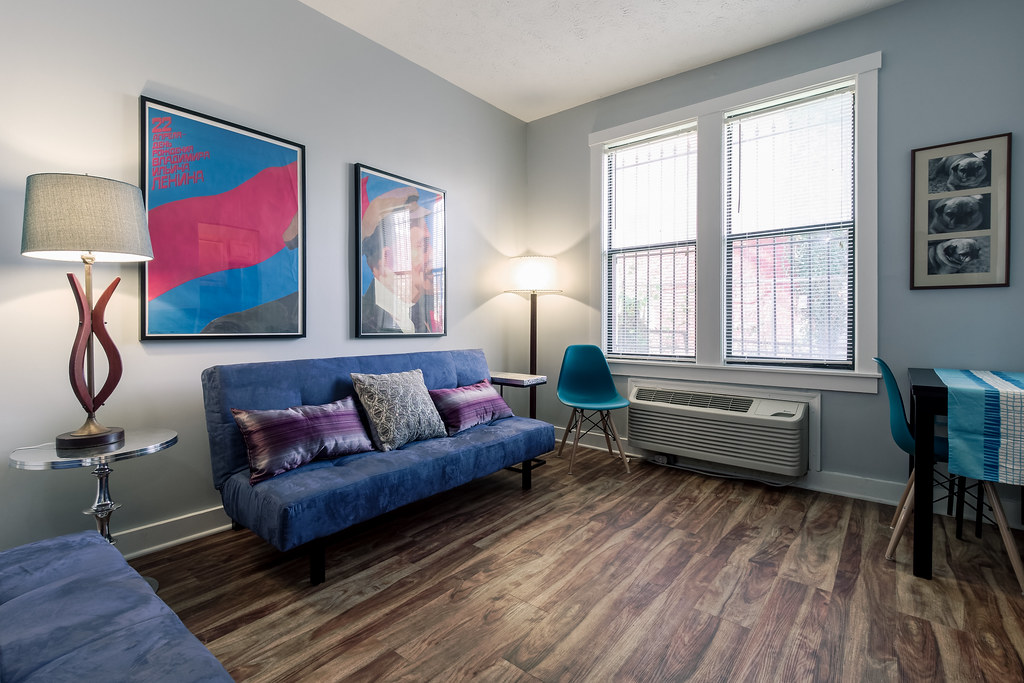 |
| Really nicely designed condo space shot for Airbnb a couple weekends ago (www.airbnb.com). Shot on the Olympus OMD E-M1 with the M. Zuiko 7-14mm f/2.8, 0.4" at f/8.0 and ISO 200. |
I've been working in the low end of real estate photography for a good while now. Calling my local market foothold a monopoly would be hyperbole, of course, but given my neglect of deliberate marketing (and even lack of a dedicated website for my brand) people know me by word of mouth, and I am generally agreed upon as a reliable provider of above-average real estate photos with low-overhead and high-turnaround time. Basically the dream for realtors dealing in sub-$300K and strictly rental properties (my shoot for Silo Point continues to be my one and only outlier in that equation... would love to have a client like that again).
Lately my idle hours have been spent navigating varied tutorials written on real estate photography, some featuring things I know already, others showcasing the different available styles currently big in the mainstream market. Naturally these tutorials showcase higher end listings, the kinds of spaces with lots of custom furniture and lighting to create a genuinely one-of-a-kind space. More than the information in the tutorials, I find myself focused on these cleverly designed spaces as subjects I really want to photograph. Sometimes I've been lucky enough to shoot such spaces on my current contracts, but because the nature of the work necessitates low-overhead and high-turnaround I don't get to invest the time and effort I'd really like to, so they always end up looking just above-average at best.
But I really want to get out of this low-end trap I'm in. I don't want to lose momentum in the advancement of my business all because of the high-volume nature of building a successful business purely on low-end work (to a degree, it's the difference between wage slavery and salaried work). Thus I am committing to a new plan of income stream sacrifice for necessary portfolio building (which also includes actually developing a dedicated portfolio showcasing website again).
Clients straddling the line between low and high-end, or who have investments in both spheres of real estate, are plenty obvious in the scheduling process based on the content of our dialogue. They usually pay attention to little details such as when the light comes through the windows, and remark on how well their spaces are lit naturally. Because the nature of my contract demands high-turnaround, I usually book these clients amid a mess of others less attentive for sake of making big earnings for that day. Currently I'm operating on a breakneck pace that fits driving to a listing, the shoot, and driving to the next listing all within tight 1-hour blocks, ultimately leaving only 20-30 minutes for the actual photography for each space (it's insane, but I'm good at operating under such pressure). Without the time to really ingest a space and deliberately consider how it is lit, I will never create the kinds of images I want to be creating.
The change I am committing to right now is to isolate these clients with higher end considerations, take the gamble on the preparation of their spaces and allot maybe 2 or 3 hours to their listing to allow for relaxed, considered, creative investment in the photographs taken for those properties. Instead of the shotgun volume of shots (4 corners of each room and 1-2 straight on, my current autopilot standard angles), I will consider only the angles which best showcase the room (maybe 1 or 2 of the strongest angles, more if the room is just that good), and develop images with very calculated techniques using flash and compositing (the kind of editing processes that delineate high-end real estate photography from photographers I admire). In post, rather than quickly punching each image with a preset and delivering as product, I will construct pieces of art that sell a space unquestionably (and not be begrudged the time investment because they will be images I am personally invested in at the inception of their capture). Rather than a mammoth block of 40 mediocre images, I will deliver 12-15 with the highest considerations.
Or so that is the ideal of how I'm envisioning this personal time and income stream investment playing out. Suppose we'll see how well it goes in practice.
The sacrifice of 2 blocks of time for standard shoots to enable this kind of invested image capture translates to a few hundred dollars in sacrificed income. Once upon a time that would have sounded awful to me, but at current it plays rather well into maintenance of mental health and retaining passion for photography as an art form beyond the burnout of photography as business. And as a happy aside, it's a liberating thing to realize your personal considerations of health and passion can comfortably trump the capitalist freight train of business.
Subscribe to:
Posts (Atom)
