Thursday, January 31, 2013

The Photo Processing Quandary (And What I'm Doing to Change Things Up)

Possibly the most frustrating aspect of the process of modern photography (and please keep in perspective the adjectives "modern" and "photography" in this diatribe... digital artists don't necessarily count) is in the editing. What's worse, it's often a self-inflicted aggravation, and one that is painfully difficult to bypass. In the context of my own experiences, when I first dove into the world of photography I was amply satisfied with a basic JPG popped right out of the camera's processing engine. Tack on a year or two and I'm still shooting JPG, but tweaking sharpness, contrast, saturation and color profiles to get it to look just a little more the way I want. Another year or two and I'm using in-camera editing options to soften skin tones and adjust tone curves and color temperatures, cropping and the classic "convert to black and white". The choices were there, albeit limited in scope and largely dependent on shooting it right the first time. Paired with minimal Photoshop tweaking they should've been the last step. The "more than good enough". Nope, eventually all of us who stick to the photography game long enough can't help but step into the RAW waters. And immediately the wealth of choice and complete lack of restraint was... crippling.

I must be clear about this point, I am in the camp of people who demand an absolute balance in all things. When I go to the grocery store and am presented with 4 or 5 different brands of coffee to choose from, at different levels of quality and price point, I am comfortable with my ability to decide and commit. Should I ever step into a coffee supplier warehouse, be faced with literal HUNDREDS of brands of neblous differences in quality and similarly vague price-to-quality values... I'd sooner burn the warehouse down than decide on a bean. While choice is a wonderful, valuable thing to have, the oversaturation of it is downright crippling.

I've been committed, more or less, to RAW shooting for the last 3 years and have yet to really find a fashion of processing with it I can comfortably commit to. Shooting strictly in JPG, options for image alteration were limited by the lossy format, but with RAW the sheer wealth of image data allows for such reckless manipulation of the image that a single frame can go from low key to high key portrait, balanced and flat tones, it can glow with intense softening or be a gritty, textured black and white. Options galore, and while some people do take the route of multiple uploads of the same frame processed in different styles, my innate application of psychology plays too heavily against that route - redundance of the same image, the same subject, inevitably numbs the audience to the subject, and the first time the audience views the subject determines the lasting impression that audience retains of it. So, in short, when I process and share an image for the first time, I am establishing the basic imprint that subject has on that audience, and it is damn hard to decide how I want the audience to feel about a subject in that permanent fashion. Especially when I have a wealth of messages I could communicate with my processing in a single image.

In my mental process of creating an image, however, that paralysis-by-choice is not present until I sit down at the computer to edit an image, usually some hours, if not days, after its capture. At the images inception, in the moments it is constructed and taken, the scene has an impact on me immediately, the scene conveys a point to me and it's very clear what message I want to share. The rub of that, of course, is that the feeling has typically faded by the time it comes to process. Were I to fine tune a JPG I could probably capture the scene perfectly with the impact it originally presents to me, however, another rub of the lure of RAW, I've become spoiled by the elasticity of the RAW files, and although my relationship to it may be begrudged, I know the breadth of editing the format opens up allows for the development of images with that much more impact. But, again, with so much time between capture and processing, even if I were to run immediately home and load the files up I would be completely frozen by a million what-ifs.
Now onto my proposed solution(s) for this quandary.

The first step involves my standards for images I elect "worthy" of processing. My galleries only offer a meager fraction of the actual volume of images I produce. Many photos I take are in candid situations, time spent with family and friends, portraits well enough composed on their own but not deliberate nor controlled. Four years ago that style of portraiture was my highest echelon, my standard, but since the growth I've experienced has elevated that standard, those candid photos often fall by the wayside when they really shouldn't. Just because an image is not artistically considered in every facet does not mean it should not be shared, especially given the capture of emotion possible with images taken in that context. My solution regarding these images, while not to deeply process them as I would my far more deliberate captures, is in the liberal use of Lightroom presets I've collected from several reputable sources. Minor tweaks combined with preset adjustments have produced images that, while not necessarily high art or gallery-worthy, are attractive and appealing in their own right and I have begung sharing them en masse across the social networks I befouled but a few months back. And they've been received in an unexpectedly positive fashion. Enough so to prompt my consideration of my next step in the process of letting go of my strict standards of processing.

For some time Olympus has had available it's PENPal PP-1 accessory, a hotshoe mounted bluetooth transceiver capable of storing, sending and receiving images from the camera to a paired bluetooth device. It never got much traction or popularity what with the simultaneous introduction of wifi SDHC cards into the market and reluctance on Apple's part to implement compatibility with the device (knock out iUsers from the market pool and that's nearly a death-seal for a device like this). In result the product is now super cheap compared to its introductory price point and, fortunately, it is completely compatible with my Samsung Galaxy Tab, a tablet I've owned for 2 years but seen an unfortunate lack of use for barring as a GPS and media player. So... here's the plan.
In the field I can compose and capture the photo as I normally would, even keeping the RAW format for a point later down the road when I may want to doctor the image with great attention to detail. Once satisfied with the capture, I can convert it directly to JPG in-camera, setting color profile, sharpness, contrast, saturation and gradation characteristics, even applying rudimentary skin softening for portrait work and adjusting tone curves (unique perks to we Olympus Elite). With the image as well developed as is possible in-camera, I can then transfer it over to my tablet via the PENPal and open it up in any number of photo editing programs, from Photoshop Express, Snapseed, Instagram, what have you. Depending on the program, an already competently handled image can then be polished and immediately uploaded via 3G connection to a breadth of social networks. And the joy of it is any one of these steps can be skipped depending on the impulse I feel in image handling that day, and should I fail to find interest in editing a RAW at the time or feel it is too high quality to suffer such barbaric edits, the RAW file can just as easily be loaded up into Lightroom for a more refined approach.

Editing on-the-fly. It's a belligerent and defiant approach to the post-process compared to the cripplingly strict set of standards I've come to apply to my choice of processed images. And while there is still a wealth of choice involved in the options of how a photo will be edited, the span of choice is still defined by its limitation given the way tablet and smartphone based photo sharing apps are by trend and nature. Editing on the tablet will either result in a hyper-stylized image using an intense preset filter effect, small, subtle adjustments of a couple key image parameters lending a gentle refinement of the image or a combination of the two. It will all be very basic and unrefined, but that is exactly what I need at this point in my growth as a photographer. Far too often I'm shoving my head in the sand, opting to ignore trends, opting to close myself off to experimentation for sake of a cookie-cutter process and cookie-cutter images lacking in that charming expression brought about only by a willingness to play around. Sometimes it's not the "perfect" shot from the model shoot, but the goofy out-take with the genuine laughter that really comes forth and calls attention. Both have their place, neither is worth neglecting.
Assuming I latch onto this new approach to the post-process, a newer, high resolution 10-inch tablet would certainly be in order. The Nexus 10 comes to mind immediately. A newer tablet with a newer version of Android would open me up to the Adobe Photoshop Touch software, a much more comprehensive photo editing tool that would favor a tablet with larger screen and retina-burning resolution. Add in pressure sensitivity response to any utilized stylus and you have a tool designed with photographers in mind.

I feel it could be applicable to the business aspects of photography as well. For some time now I've been trying and failing to develop a solid portrait market, always falling short due to an inability to narrow down a target market and appeal to them directly. As of yet, it's still just friends and friends of friends, which I can't really complain about because it's still fun and good practice. But introducing tablet-based editing to the picture, I could easily see handling a candid shoot for an hour or so on-location, then heading to the nearest coffee house, grabbing a latte and sitting down with the subject to sort through the images, pick the winners, transfer them to the tablet and edit them not just to my taste, but to the subject's. Collaborative portraiture, eliminating the wall between photographer and model in the post-process. It could be an interesting engagement.

More difficult than anything is keeping oneself open to innovation and sweeping changes. It's easy to become stubborn and shoehorn one's entire process into standard battery with no relief, no deviation and far too much self-imposed pressure. Even with the business aspect tossed in, photography is not "srs bzns". It is not a life-or-death affair and with the basics down you are not being pressured or judged by your output. Processing is relatively new dilemma in the photography world, once the realm of graphic artists and dedicated film developers. With the advent of digital, photographers are inflicting upon themselves en masse an extra step that was never theirs before, and it's not necessarily the easiest skill to learn, especially with the constantly changing standards of how and where an image is displayed (we certainly aren't making prints much these days, and show me two screens with the same color rendition and gamma and I'll show you where Jimmy Hoffa is buried). We're learning two skills these days whether we like it or not. No sense in swimming against the current - embrace it, let yourself flow and somewhere downstream, where the waterway forks, you'll know where to float.
Thursday, December 27, 2012

A Dark Path, A Broken Flashlight

Once upon a time I posted to this little corner of the Great Big WWW with great frequency at a time when I felt mentally disorganized and woefully incapable of straightening out my core motivators, the direction of my muse. It was a good practice, and right now, time permitting, a practice whose reinstatement would behoove me.

Let's start with what stands out to me as the event of greatest impact on my process of photography and a very likely culprit in my dilemmas of late. My copy of Photoshop "expired" and, due to monetary concerns left me tied to acquiring and learning Lightroom in its stead. Doesn't necessarily sound like an enormous switch, both programs are stellar pieces of Adobe imaging software, but let me tell you... from a guy who has spent over a decade comfortable with and familiar with layers and the nuances of digital art, not just photographic development... MOVING TO LIGHTROOM EXCLUSIVELY AFTER YEARS OF A PHOTOSHOP PROCESS HAS BEEN IMPOSSIBLY DIFFICULT. Developing RAW files as one does in Lightroom has always been simply the first step of my Photoshop process, thus leaving every image I process feeling incomplete. I am so familiar with an array of layer-based adjustments after the initial development of a RAW file that I'm not sure my images will ever again manage to bear the same tonal qualities and infallable crispness. Having a perfected decade-long process interrupted and ultimately abandoned due to software constraints is akin to a chef losing his hand. Sure, he'll be able to prepare delicious courses much as he did before, but even the subtle differences from his forceably altered process will stand out at least to him. It comes down to a time concern, time and a willingness to learn. I certainly bear both, however it has been something of a struggle much as all learning inevitably is in the beginning.

Okay, that's the biggest issue out of the way. And honestly, my First World Whining may as well stop there as I didn't zero in on any of my other "problems" until the Photoshop Fiasco, but like all changes or life events that get us even the slightest bit down, the mind tends to autopilot itself into other subtle woes just to indulge itself in some artificial misery.

I've (temporarily) lost focus on what exactly it is that motivates me to photograph. Personally, I find this quandary absolutely dumbfounding because not 2 months ago I felt I had finally narrowed in on what it was that made be genuinely thrilled to participate in the practice of photography to begin with. It's as if the personal revelation of that core muse's discovery forced it to crawl away in clandestine fashion to some new, unexplored corner of my mental triggers. Or, perhaps (and even worse), the unveiling of the muse's most basic operating structure has left me without anything left to learn, and the slow, inebriated trudging pace of my photography today is the result of the thrill, the adventure of self-discovery being no more. Or, if I were to actually stop reading so heavily into the abstract and just pay attention to the supremely logical hemisphere of the brain, maybe I've just slowed down because of weeks spent ill, recovery from surgery and family-centric holiday events bunching together and attacking my time and stress centers all at once. See, I can state that and totally believe it, that my stark decline in creative, artistic photographic efforts has simply been a result of life-outside-of-photography weighing in, but it is also a function of the brain to look at other people, their exploits and efforts, and thus when my brain sees so many good friends enjoying the season in photographic fashion it immediately assumes some greater, deeper issue is at fault and denying me the satisfaction of creative expression.

I'm not sure if I've ever said this before, but our brains really do rather suck at permitting us complacent satisfaction. That or I'm simply crazy... suppose both statements aren't exactly mutually exclusive either... hmm.

I have hit a woefully jaded peak of disinterest in urban exploration. At least UE insomuch as the infiltration of active, semi-active and guarded locations is concerned. In 2008, when a brand new and exciting genre to photograph, my enthusiasm in urbex outings couldn't have been higher. In 2010, having spent 2 years honing the craft, I felt myself moving at a brisk pace through location after location and pulling winners from the asbestos every time. In 2012 I found a troupe of like-minded photographers and dove into the practice of UE on a nigh weekly basis, culminating beautifully into such memorable nights as a derelict wine & cheese party, amazing road trip through the Borscht Belt, kayaking to abandonment, train hopping and a million witty quips and inside jokes that will honestly make this year one for the memory books. An amazing year with amazing people... and now suddenly it's back to (at least feeling like) to just me. The last location I explored with my fellow UE partners-in-crime, a location that had been off-limits for some time but once again opened up, was so brutally disappointing to see nearly a year after my last expedition to the locale I've been left with a general disdain for abandonment in general. That location had been the defining moment in my early exploring pursuits, the kind of place that propelled my motivation and served as the best subject by which to perfect artistic technique. Whatever took place in its year spent out-of-bounds left the place a hollow shell of its former self, grandeur gone runny and now a muddy stain on the carpet. It was a story many abandoned locations in the home State had undergone, and that not even my original muse could escape the doom of rampant vandalism and "urban renewal" broke the spirit of exploration down for me.

Urban exploration has effectively ceased to be exlusively defined by places alone and now depends overwhelmingly on the company kept during an explore and the ridiculous fun had on location. Much of this overbearing mental trend stems from my great appreciation of the work of Eric Tankel, a Philly explorer who, as he expressed to me, "...suck[s] at taking pictures of abandoned places so [he] just photographs people in them". His work unloads mountainous memories to me and I have no idea who the people in his photographs are. They put me in an experience, in an attitude that elicits maximum appreciation of life, and I want to brandish such a talent myself, I want to be able to share the experiences I have with dear friends on explores in such a subdued yet amazingly impactful way. It's a kind of Holy Grail... and unfortunately for me one that requires a less reclusive, people-evasive nature (something else I'd be doing myself a favor to work on).

In the near term, since the "personal life" of photography is such a mess for me at the moment, I've been steadfast and focused on more formal business elements of photography, which is a good way to at least keep my mentally centered on the skill and keep my warmed up at all times. You can't make art all the time, I suppose, but at least with the business end of things running my mind and hands through the technical motions I'll be practiced and prepared when the muse-bug bites hard. After so much time spent out of the game I'm eager to get back into the enjoyment of photography. It's all a matter of needing mental clarity to know the what, how and why. With the holiday season coming to a close, I suspect that clarity is fast approaching. It better be...

... I think booking a vacation in Philly might do the trick.

Wednesday, December 26, 2012

New Toys, New Business, and The Gear Quandary

What a truly exhausting, yet enthusiastic year this has been.

Yesterday, like many of us, I was busy in the thick of celebrating the holidays was various circles of friends and family. A few days earlier I attended (and somehow wound up photographing) a dear friend's wedding and immediately afterward spending time with one side of my family for their early Christmas festivities. Cruising down from 4 hours north, a friend of my better half and mine came down to spend the week with us over Christmas time in what has been a non-stop binge of movies, video games and delicious food. And yesterday, as expected, more time was spent with the remaining side of my family in an enjoyable parade of giddy kids who were surprisingly open to the idea of smiling for the camera. What a holiday!

Naturally gifts were exchanged, and en lieu of my desperate push towards legitimizing all the time I devote to photography and its practice, the assortment of gifts I received this year were very specific assets that have been like missing links, holes that needed to be filled but I've always been too stubborn to buckle down and purchase them. And, oh, are they welcome additions to my toolbox!

Long as I've been doing real estate work, I've always just managed to make certain scenes work, often situations with a large, bright window with sunlight pouring directly in it. A situation where some measure of bounce flash for help tame the exposure. And much as I love the CFL studio lights I own, there's always been the want to take the stands and lights on-location, somewhere they would ultimately end up uselessly deprived of a power outlet. I'm extremely pleased to announce that these scenarios are no longer of issue or concern, and part of what I'm going to coyly dub my "Business Gift Pack" were a pair of high-powered manual speedlights, paired with radio triggers, and a new set of sturdy, rugged light stands with speedlight mounts (with umbrella slots) and sandbags for when shooting in the field. At least, a field-able portrait kit is at my disposal, and never again will I fret at sunlight invading a room through the window.

They couldn't have come at a better time in my ongoing endeavor to establish a strong photography business. Earlier this year, in February I believe, I wrote a long, elaborate business plan as a sort of guide to determine what and how I wanted to grow as a business entity. A very sizable portion of that plan focused on portrait work, both candid and studio, as being a sort of bread-and-butter element of my efforts. As the year went on, my focus shifted much as it should be expected to over time. I had one major commercial job and for a good couple months following I was enamored with the idea of pursuing commercial work, and only in the past month or so have I really settled on the fact that pursuit of commercial work may very well be the great lost cause that ruins many a rising photographer. With that hopeless ambition out of my system, however, I'm once again back to basics, refocused on my original plan and aiming to open up my business to a new market.

Over the next month or so I plan to keep busy perfecting a process by which to handle formal, paid portrait photography work. Now, granted, my "test subjects" are all currently friends or people I otherwise know already, thus negating the spell of woe that is breaking the ice on initial meeting, however I am confident that easing into a shoot, bringing the subject to a comfortable point whereby the images just flow, is something I wouldn't find my difficulty achieving what with my experience in conversing and easing the minds of real estate clients I've met (and in some cases befriended) over the last year. Producing that kind of ease, that peace of mind, I suspect would be the most difficult aspect of any portrait shoot, so at least if I can perfect the shooting process itself to the point where it's no conscious worry on my part all real effort and focus can be directed to the subtle mind games involved in ensuring the subject is most comfortable with where they are, who they're with, what they're doing.

With the heavy hitters in lighting equipment graciously gifted to me, last night I took it upon myself to complete my kits completely with the frivolous little things missing from my camera bags. Red filters, step-up rings for lenses thus far lacking in proper filter usage (M. Zuiko 45mm f/1.8, I'm looking at you), and lens hoods and accessory port attachments for my Nikon V1. Another lovely gift I received this holiday was the Nikkor 1 30-110mm f/3.8-5.6 lens, something that seems outside of my usual circle of appreciation for fact of it being a zoom and long telephoto, but given the nature of the V1 and the simple fact that, sometimes, you really do need a long lens, it adds an entirely new realm of capability for me, something I've not had since dropping DSLRs 3 years ago. With the crop factor in mind, this 30-110mm lens functions much more like a 70-300mm telephoto, and paired with the V1's breakneck speed (I mean, come on, 60FPS in electronic shutter mode...) photographing wildlife and sports has once again become a realistic possibility for me. And, even though it may be a zoom, the uniquely close focus distances of all Nikon 1 system lenses makes it a fantastic portrait zoom capable of producing appropriately shallow depth of field based not on aperture, but the element of DOF rendition that far too many seem to neglect, proximity. I would be lying were I to say I was not absolutely excited to try it out. Inclement weather forecasts be damned.

Admittedly, the surge to completion of my V1 kit has befuddled my mind a bit. Originally, when the V1's price finally dropped down to something I considered worth investing, my idea was that the V1 would effectively replace my point-and-shoot Olympus XZ-1 as the carry around camera of choice. Oddly, that doesn't seem to be the direction I ultimately took with the 1 system at all. Once all of the items I ordered arrive, I will have essentially a miniaturized clone of my old D40 kit that I will forever regret selling in 2009. A pair of kit zooms, 27-80mm and 80-300mm equivalents, a nifty fifty, flash gun for on-the-spot TTL metered shots indoors and a remote for if and when the camera ever finds itself on a tripod. This flies in the face of what the system was meant to be to me. I find myself experiencing the same perplexed stupor as the well known Steve Huff - "I did not expect to love this camera". Something about its brutally simple, utilitarian appearance, it's down to basics, down to business function... it is simply a fun camera to shoot. Megapixels shmegapixels, I was printing 16x20" prints just fine with my D40 just a few years ago. And with that gargantuan battery I feel completely comfortable leaving the house with one for the day and having plenty of charge on it for even a late night's worth of long exposures.

This, of course, makes my brain itch slightly when I consider how much I do still love my Olympus kit. It's difficult for me to maintain multiple camera systems as I imprint a sort of emotional value to each. When I use one overly much, part of me feels that I'm leaving the other feeling neglected, and that would absolutely describe how I feel about my poor E-P3, stuffed in a bag and only ever seeing the light of day for real estate jobs and the occasional night shoot. With the remote coming in, I fully intend to try night shooting with the V1. Miserable as I felt it was the last time I used it on a tripod, I suspect that after spending so much time with the camera and learning its nuances I'd be capable of working with it more comfortably now than before. This all, of course, solidifies my real quandary - why am I maintaining two similarly capable systems?

In the end it really does come down to the abstract of what feels right at the time. That kind of nebulous logic flies in the face of my devotedly logical, rationalizing brain, however, and so I remain in a state of constant question as to which camera really does best suit my needs at a given point. Looking at things from that logical standpoint, I can say that the V1's high ISO performance and formula car shutter speeds make it ideal for anything moving, and its image quality is not terribly apart from the E-P3's when practicing good technique. In the Olympus, court, however, the optics are far superior, and while it may not be a champion of high ISOs, it is an incredibly pleasant camera to work with when the subject matter is still, static, and the resultant image a thing of intention, not simply reaction. This of course begs the question "Then why not just get an OM-D and close the gap", to which... I am stumped. Speechless. You got me. Much as I would like to own an OM-D... I don't. And when I eventually do upgrade my MFT body... will the V1 feel kicked to the wayside next? I find myself dwelling on quotes about being spread too thin... who knew just 2 systems would polarize this much?

In the end, of course, I can at least state with confidence that, although I enjoy shooting with the V1 and do tend to carry it around and shoot with it more, the photos I'm taking are rarely of a superb artistic quality. It tends to be the camera I shoot family gatherings and social events with, not art so much as function. The E-P3, on the other hand, remains my go-to for intentioned artistic shooting and working jobs, and it will likely remain that way even once my MFT body is upgraded to the next PEN or the OM-D or whatever fits the bill. The V1 remains my little experiment, and while it may take some attention and budget away from solidifying my MFT assets, it still seems a worthwhile venture. After all, the best camera is the one you have on you all the time, and I certainly carry the V1 around far more willingly than lug around the MFT bag.

How typical... I steer away from DSLRs because they're too big and heavy, and sure enough I'm starting to treat MFT the same way because there's a new champion of tiny sensor goodness in the ring. My logic centers are an absolute mess!

Monday, December 17, 2012

On Losing Steam (and getting it back again)

After months and months of putting prose into practice, of applying myself and dwelling less on the informal application of theory and thought in my craft, I return to this blog with one assured sentiment - I finally know where I'm going.

Now, with that statement made, let's work on making it less nebulous.

Some time in August I hit a curiously low point brought on by self-imposed, manufactured stress in regard to the effort required to promote my brand. So overwhelming was this stress that it brought on a recession from the marketing binge I'd engaged in prior. Seeing little result from what felt to be gargantuan efforts, I became disheartened, retreated from the legions of desperate upstarts trying to establish a strong name for themselves and acquire new business. Those efforts had only ever resulted in but a single commercial shooting arrangement in my court, and the headache of Web 2.0 quickly lost its allure. Coinciding with my deflated enthusiasm, the company for whom I often photographed property listings had hired another photographer who seemingly devoured the majority of my shooting gigs.

My optimism tested, all that was left was to submerge myself into a forray of personal adventures. Artistic shoots. And I absolutely appreciate their effect, as I've never felt more aware of my baser motivations.

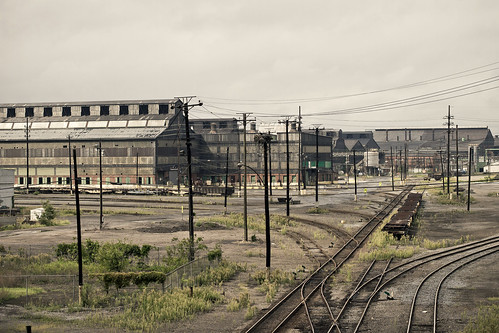
In September I spent much of time photographing a local steel mill that had gone the route of much of America's once proud steel industry. I was inspired by the work of Edward Burtynsky, whose work I'd seen documented in the film Manufactured Landscapes. His years-long series of photos covering the scars in the Earth left by modern industry and strip mining efforts struck me as notably poignant, even definitive of what I found myself trying to express in much of my urbex photography. Until seeing another's work, the creative fruits of a well established photographer, I never quite understood what it was that I was attempting to express myself, but understanding Burtynsky's theme, his direction, and how he defined it before ever engaging in the photographic process... it made me rethink my own approach to photography. My work had always been documentarian at best, with little point outside of what was in the frame to be seen. Suddenly I found myself wanting something more from my own photos. Documenting a rarely seen place was no longer enough, it needed something personal.

But I didn't know what. And for a good while I had no idea what it was that I craved out of my own images. I continued working like some automoton photographing places in a formulaic corner-to-corner approach much as I'd photographed everything up to that point. A good friend and I went on a week long road trip through the greater Northeast region of the States and despite firing off many hundreds of frames not a single one spoke to me. They were all the most boring photographs I had ever taken. But the experience of being in the places in which they were taken was so rich. A bridge needed to be built, some pathway by which to correct the awful disconnect.

I suppose it had clicked before, but it took time for me to dedicate myself to putting it to practice (and admittedly I'm still working to apply it to my shooting more earnestly). It was people. The people I was with, the ones I was sharing experiences with. It was never the places themselves that bore the bulk of the memories, it had always been the conversations and the antics and time shared with unique and wonderful people. When shooting on my own, for fun in this sort of manner, the photos that mattered had always been the ones that featured those with whom I was shooting. So foolish that it took so long for me to recognize.

Despite seeming so obvious and simple now, that was a huge epiphany to me in September. It took a good amount of time shooting with my "Bro from Philly" for me to recognize it. It was a concept that had occured to him long ago already, so I more or less felt like I was playing conceptual catch-up with him. As a result, I found myself shooting less, but the crop from personal photo outings being that much richer in end product. Finally it all clicked (pardon the pun), and I spent far more time enjoying my friends' company on urbex adventures than wasting my time hunting behind a lens.

Oddly (or perhaps not), the establishment of my realigned focus on the people, not the places, coincided with a lessened interest in urban exploration per se, but certainly not a diminished interest in being in rarely seen or unique places in the company of those with whom I most connected. While still embarking on the occassional urbex run, the state of decay and abandon of the locale became less interesting to me than the simple uniqueness of the place and the quality of the people. Instead of sneaking into mills and hospitals, I relaxed on 500 foot high cliffs until the stars populated the night sky away from civilization. I made bonfires on beaches sandwiched between Baltimore's finest in industrial assemblage. I spent nights under bridges and recounted life's trials and tribulations on long walks down train tracks. I watched people wander like ants from rooftops for hours. All moments I did my best to capture with the perpetrators in context. People. Not just places.

That missing satisfaction from my personal photographic pursuits realized and addressed, I once again felt in a proper place of mind to return to the business-centric approach to photography that defined the first half of my year. Not because my personal shooting was in any way affecting my business approach to photography, but after having exhausted myself with marketing and promotion, the peace and order I'd come to with my personal endeavors came with a fresh surge of motivation, ambition. Like having one's finances in order, a sense of clarity and control returned. And almost too coincidentally, the company I was contracted to for real estate photography conducted an audit of its photography division, culling its photographer roster by a significant amount... but deeming my work and my methods of conducting business worth keeping. A more reassuring indicator that my business sense is sound... nope, can't think of one.

Once again recomposed, I know what directions I wish to head in. They are somewhat divisive in that they both require different approaches, but neither approach wholly excludes the other. But honestly, my problems being squarely centered in the "what gear should I invest in next" department is reassuring in its own right - my methods are competent and in many ways superior as evidenced by my retention at the hands of bloodthirsty auditors. What I have established now is just fine, and while equipment acquisition can make my job easier they won't bring anything particularly new to the table that my method doesn't already provide. My new business focus is more appropriately focused on expanding to new markets.

In the beginning of the year I wrote a business plan that largely focused on portrait photography as a platform on which to expand. To date I have done absolutely nothing to establish myself in the portrait photography market. It exists, I've seen it put to practice by many local photographers, but they apply their craft in different ways than I intend to implement mine. It's like a trump card, or maybe an Ace up the sleeve. I only need to apply myself to it. Unlike my real estate work, there is no larger company feeding me clientelle. But I suspect that I'm already well known enough to where finding eager clients for portrait work wouldn't be difficult. Establishing that new market for business is my goal for 2013. And I've never been more ready to take it.

Wednesday, August 22, 2012

Web 2.0 Is A Headache All Its Own

Remaining market relevant in this new Web 2.0 world is nigh impossible without autism-like tolerance of mundane repetition and obsessive site checking.

Allow me to elaborate.

I come from a much simpler experience of the Web. A simpler time. Before the flood of content over-saturation mania and DIY cookie-cutter media sharing constructs. The idea of the "social network" didn't exist yet, and all interaction over such forums as news boards and chat rooms and discussion boards were much more personal and relevant because the user was not rewarded for talking to himself and patting his own back, he was rewarded for strong talking points and relevant contributions to the discussion topics of his board(s) of choice. The internet was a thing for intellectual people. Phenomena like the "troll" didn't exist yet. Categories were only beginning to be established to block certain user personalities into for purposes little more than of witty humor.

The most creative and progressive among the early internet crowd took the digital presentation of their art to a level of art as well. It wasn't ever enough for artists to simply pay someone else for a standardized set of web code to generate a site. The artist took pride in his creativity and created his own page from scratch, fine tuning every line of HTML to produce a visual assemblage that elevated his work by proxy. For the young creatives, the domain was never important - hosts like Angelfire and Geocities existed expressly to offer those eager to pioneer digital media sharing easy access to server space and bandwidth. Genuinely a beautiful thing, and the empty husks of these antique web pages still exist today in the surreal muck of dead server space.

Enter the world of Web 2.0 and it's incredibly difficult to specifically trace when the web went from content and creativity rich to ADHD and media binging hyper saturation. It's a world I find very difficult for anyone to ever dream to achieve any measure of market permanence in.

I preface this entry with early WWW musings as a contrast to the complexity of the modern web and what I am currently engaged in to promote a brand and achieve even a glimmering of relevance to the transient interest nature of the web. And the photos serve as my private expressions to that sugar-juiced toddler, the "crowd", the thing we as budding content creators absolutely must grab the attention of and bend into pretzels to keep a firm hold on.

This year was met with a revelation that achieving my goal of breaking into the professional photography industry would require a concerted effort to develop a stand-out brand, organize that brand into a marketable service and then promote the living hell out of it. The brand itself was solid and the service spoke for itself, but the effort involved with promotion was not only daunting up front but an ongoing harbinger of mental fatigue. I made my first mistake of trying to push the brand on the whole "crowd", and the lesson learned was to unhinge from that crippling load and target precise crowds most desired and most appealed to by the service and brand. Resulting was a Facebook page to promote specific points of interest to the Kneejerk Imagery brand, heavy engagement with the Flickr community to distribute content as a sort of sample of my service and this blog to create a much more personal forum by which I could speak frankly about the business and keep it rather humanized (maybe more of a personal need than a business one). This trio has worked well for me, and with an established consumer base sampling my content via Flickr, keeping track of my business interests and direction over Facebook and keeping track of me through Blogger I've managed to book paid photography work at a rate I never thought I would achieve so quickly, which begot other work through good rapport.

I kept up with the trend by keeping up with the process, the system for success I had stumbled upon. February of 2012 saw the initial rapid incline and by June it had peaked with my first commercial shoot. With that rate of success I felt absolutely unstoppable, like I was going to ride the lightning into a complete career shift, abandon my mundane 9-to-5 and actually realize that long standing dream of working exclusively as a professional photographer. Now... not so much.

Web based content, especially memes and similar such pop culture fads, have ridiculously high turnover. The social relevance of media has a half-life of maybe a few days before being replaced by the next adorable cat photo, Youtube idiot or Troll Face meme. This is an accepted facet of web content, that we collectively pile onto a viral piece of media, consume it like ants to bones and discard it. Much as I understood this concept a mental disconnect slipped in somewhere to lead me to believing such voracious consumption of media and content did not also apply to the consumption of brands and one's relevance to even a targeted audience. And now I am paying for it. I skipped a beat on maintaining the change, and now my market relevance seems to be waning just 6 months after it surged so beautifully.

Every statistic tracker tells the same story. Over the course of July 2012 my "popularity" faded just as quickly as it had surged. And this speaks in the income hit I took in July as it was also my driest month in regards to photo shoots. In June I was booked for 3 to 4 jobs every weekend, a healthy supplemental income. I took real estate jobs, corporate head shots, commercial shoots... business was bustling and the customers I had were more than impressed with my provided cost value. But in July it all disappeared. I received no phone calls or e-mails to book shoots. Out of curiosity, I e-stalked a few of my former clients, initially with the intent to then contact them about future servicing needs, but instead left dumbfounded and devastated by what I'd found. Their service needs were still there, they were simply getting content from someone else. As cheap and as good a service I provided, they still managed to find someone willing to go cheaper.

Thus the almighty dollar won out.

This isn't a problem I've not run into before. In my earliest days pursuing the professional photography dream I spent a good amount of time in the small-time wedding photography business. It was the same story there - as cheap and as good as my results, there were always competitors who may not have provided particularly good quality images but they were cheap enough to trump my influence. In this instance, however, the issue isn't simply a matter of being undercut. All of my working relationships were developed online, through my branding, through my self-promotion and marketing tenacity. But none of that was working anymore. I'd become stale to the crowd. My relevance to my target audience had gone the way of Double Rainbow Guy and Tay Zonday. The only option left... find a new crowd. Target the next audience.

With my established formula now a bittersweet mushy strawberry that sat in the fridge too long, I'm branching out to other media sharing sites and networks I could use as promotional carriers. And you know what? It's a pain in the ass.

Of course we are all resistant to change, it is a common trait among nearly all human beings. When something works we are reticent to change no matter how much evidence is shown stating it doesn't work anymore. That's not my issue right now. I understand a change needs to happen and much as I will miss being able to ride the wave of the process I'd established I'm sure I'll settle into a new one with my new market approach. My complaint is that the next logical step in the infinite war of maintaining market permanence is to indulge the web in its fickle, consumerist habits and hyper saturate my exposure. And it will be the biggest sink of wasted time, all for sake of keeping the jobs coming and keeping some semblance of a dream I'm starting to dread alive.

Let's go through the laundry list:

First, I'll spend upwards of 30 minutes to an hour editing an image. I will then upload this image to Flickr, as complete as possible with numerous tags, a witty description, add it to dozens of groups to push its web presence through the roof, okay, good. Now, upload the same image to 500px, tag it some more, fill out the gear-snob portion, lay on a thicker, more detailed description, done.

Oh wait, that's not right, I need to troll through legions of amazing images by other artists and comment and favorite on them too, else I don't get noticed at all on 500px and I lose my photo presence in groups on Flickr. Rinse and repeat this process at least a dozen more times because the relevance of a single photo on the web is nearly non-existent if not followed up by a series of somehow related images. Now share some of the images on Tumblr, adding witty captions as necessary to sound moody, brooding or otherwise quirky and aloof. May as well post links to those images on Flickr, 500px and Tumblr on Facebook too, since everyone and their mothers use Facebook. Tell you what, though, better make some blog entries about the whole process being such a pain, too, and make sure to link in some of those photos uploaded earlier. Now go to DPReview and 43Rumors and UER and all the discussion groups on every photo site imaginable and post-whore (with relevant, but redundant information since no matter how many times you tell someone what ISO, aperture and shutter speed do there's always a long line behind that guy waiting to ask the same question). Might as well milk DeviantArt's waning market relevance for what it's worth and cross-post there, too. Maybe on FA, too, just to culture shock the site's target genre. Whoops, forgot to update that Model Mayhem profile with the new portraits I just uploaded, better do that too. Oh man, gotta reply to all the flooding e-mails about comments on those forums and Flickr images. Uh oh, I've had the second portrait open in Photoshop 3 hours now and haven't had the time to finish it and it's already midnight.

It's obnoxious. Absolutely obnoxious. Web 2.0 is a reward system for lab monkeys. In a perfect world, I would be able to process my images, upload them with a single client to "the cloud" and have them shared across all the image sharing sites I took interest in making accounts for. That and maybe a page to promote the business for the business' sake and a blog to rattle off fragments of my mental haze. Instead, I'm forced into this ridiculous rinse-and-repeat process, going through the motions as insincerely as warranted just to merit the attention necessary to reach the key players I'm targeting to book work and sustain my business. It slows me down. I cannot produce content nearly as quickly as I did under the inherent pressure involved with hyper saturation. Ultimately, this depresses me. I would rather process and share photographs for the sake of processing and sharing photographs, but to make it a sustainable business it is requiring the kind of mindless effort that is draining my motivation to continue the pursuit. Depressing.

The Web 2.0 marketing treadmill is putting a major point into perspective. I cannot do this all on my own. There is not nearly enough time for one person to engage in and complete all of the tasks necessary to self-promote in this fashion while simultaneously working a traditional day job. Clearly, quitting work just to promote a business model that barely brings in my current "traditional" income is out of the question. Best as I can perceive, the only reliable solution would be to hire outside help. An "agent", so to speak. Someone whose full-time job is my marketing and brand recognition. Someone with the network to capitalize upon.

But I don't quite think I'm at the point of hiring an agent yet either, so... temporarily SOL.

While the job pool has dried up significantly, at least some are still coming in. I don't foresee any measure of reinvention making a lasting difference at my current stage of professional development, it's down to a simple matter of business model adjustment, perhaps even a change in target audience. Before, my efforts in over saturating the web with my brand was a brute force endeavor to strong arm into the industry. It was successful, for sure, but now that I am in the industry, perhaps continuing to saturate is the wrong approach. Instead of carpet bombing the web, I would see much greater benefit from precision striking the fields where I've already gotten work. Adjusting the brand to be less strikingly fringe and instead more refined, clear cut and professional. Less image site spamming and more corporate client business card trades.

Hmm... perhaps not so SOL after all.

Friday, July 27, 2012

Scatterbrained Update

A couple things.

First, I put my conformist hat on and joined in on this whole tumblr bandwagon. If you'd like, you can catch my work and little snippets of faux wisdom at http://kneejerkimager.tumblr.com. Warning you, though, I'm still getting used to the thing. And I'm pretty much devoid of social skills with its inherent community.

Secondly, I would like to apologize for my mute trend over this forum. The days have been busy, and only all the more difficult in the past 2 weeks. I'm sure a more adequate monthly review will come once the flurry of activity dies down in my professional life. Oh the woes of the working man.

Third and lastly, I've been in some rather engaging conversation with a certain someone over our respective approaches to photography as less a hobby and more a lifestyle and more importantly the trials of our private lives and how they seem to seep into the work we produce. Earlier this morning I made something of a series of confessions to him, confessions I feel compelled to share in this far more public space. Without further adeu:

"Sympathize on the whole "I'm not occupied" point particularly. I'm bored all the time, too. Video games don't hold the same allure they used to. Without driving off somewhere I just go nuts sitting around and stewing over how I wish I was doing anything else but sitting on my ass and staring at Facebook in less-than-giddy anticipation of updates. I think it comes down to the adrenaline junkie nature of urbex in general - we go to amazing places, do amazing things, see amazing things. When we return to the normal, functioning world, it's like we suffer a low-grade PTSD. There is nothing extreme, nothing incredible about the flow of our normal lives. We are never putting ourselves in grave danger or engaging in outright stupid acts of acrobatics, B&E and/or evasion. It's a safe world. It's a hugbox. And we're so much happier to feel the extreme of knowing our lives and livelihood are in legitimate danger.

That weird sense of post-traumatic stress had me drinking a lot, again drawing a parallel here. I'm actually just a week and 5 days sober, forcing myself to cut back on the drinking for a while. Even cut coffee out of my life since I was downing shots of espresso like a junkie. Everything in excess. The coffee made it impossible for me to relax and the booze gave me the false free ticket to do crazy stupid things from getting kicked out of places to starting fights to "urbexing" construction sites and falling out of second story windows. I was breaking myself in every way possible, and I liked the feeling of being broken. It was a private thrill to wake up after the nightly bender, figure out what I broke, what I lost, who I pissed off and put things back together again. It made me feel substantiated in the weirdest way. Nobody can put himself back together at the same pace he can tear himself down, though. It needed to stop, hence this current sobriety trial I'm putting myself through. Uncomfortable places. Like you said.

I think we're all desperate to be immortals. Artists, I mean. We feverishly record our lives, our points of view, the things and people we see, how they make us feel. What we do when we're bored, alone and can't figure out why we're still breathing. Our art is our cry for attention. But not just the attention of right now. We want the attention of some kid who stumbles upon an old shoebox in an old house 100 years from now and can't help but read the words on paper or shuffle through the polaroids. In this digital age it's harder to garner more than a fleeting existence in the attention of the masses. We are a culture of disposable talent, disposable people. Internet fads. But we'll figure it out in the end. We're just that persistent. We want to be remembered."

Wednesday, June 20, 2012