Tuesday, November 3, 2015

What am I even doing anymore?

Couldn't have arrived in time to photograph this bit of clever street art at a better time of day.
Shot on the LG G4, 28mm, 1/600" @ f/1.8, ISO 50

I notice many of my favorite photographers and photographic projects have some sort of overarching story to tell. Their work isn't singular and disconnected as solitary pieces of exceptional work. Rather, it's a collection of above average to pretty-damn-good facilitating the narrative. Personally I'm trapped in this awkward inbetween stage of development in the craft wherein I can either specialize and go the way of the Fine Art Photographer (FAP, hehe) or chase the narrative and call it Lifestyle Photography. My muse vacillates wildly between the two depending on my mood at the time, more often than not leaning toward lifestyle work but holy crap is it hard to set aside the time to sort through photos and assemble a narrative. I don't want to upload sets to Flickr to share openly because they mean nothing without that underlying story and are thus merely above average photographs (maybe I'm too self critical, or perhaps taking my Flickr gallery too seriously).

Suppose the overarching point is I'd like to write more about the things I am doing, and I spend a lot of time lamenting my failure to share those stories. Normally I'm against permitting myself excuses, but in this case I'm going to squarely fault working constantly. All the time. 9 or 12 hour workdays in a claustrophobic office among people with whom I have nothing in common in an industry not in the slightest aligned with my personal ambitions. It's a pretty goddamn draining existence to deal with, and at all uncommon for me to be absolutely braindead by the time I get home with little interest in anything above eating dinner, playing a casual game or something equally less demanding of brainpower, and going to sleep. Motivation to do literally anything productive is just completely sapped because I've spent an entire day managing my own misery. I do this 5 days a week, and then when the weekend arrives I've saddled myself to the brim with photography work, which is infinitely more thrilling and motivating, and the struggle to make it a viable replacement for Misery Management is totally worth it, but it's also very time consuming and again I'm left with little bandwidth to express any narrative with the necessary agency to do it justice. Which is why pretty much every blog post you see from me is written while I'm at Misery Management with some down time between tasks.

And I've been up to some cool stuff lately. Took a trip to Philly, took some photos for the BGE Baltimore Before & After photo gallery and took a kid's portrait that wound up flaring up some weird emotions when casually posted to Reddit. I shot my friends on Halloween at a country bar with line dancing while they were dressed up like a donkey, a sock monkey, and Michael Vick's dog. Looking back on the last 3 weeks in such short and sweet terms reminds me that my life is awesome and totally worth sharing because there are lessons and discoveries to be made about life and people and relationships by recounting them. And damn does it seem greedy to be keeping that stuff to myself. Pretending there's some charm and appeal to being the mysterious photographer who wanders, aloof, in and out of life without any lasting imprint is bunk. I'm not mysteriously fading in and out, I'm simply working so much I don't have much time to actually exist as my own person instead of a means to someone else's end.

It's kind of early to be committing to New Year's resolutions (they're kind of dumb and arbitrary anyway...), but I suppose it's never too early to set a goal for myself to make the time to be me for more than scattered weekends at a time. I thought setting aside one weekend a month for myself was a great step forward, but in reality it's put into very clear context how much abuse I've been allowing myself to inflict upon... myself. I mean, for fuck's sake, who actually has to mark time off in a calendar to just be themselves.

Friday, October 16, 2015

High End Smartphone Photography with the LG G4


Apologies for the sudden and abrupt dry spell. It seems I am only ever able to maintain a steady pace of publishing for a few weeks at a time at best, inevitably followed by a months-long dry spell in which the focus to sit down and produce written content is elusive.

The last couple months have seen a series of fun outings strictly designed as Photography for Me endeavors. Finally agreeing with the assessment of my peers regarding a breakneck, burnout-conducive pace of Photography for Work, I've made it a point to reserve at least one weekend of every month for myself, and on those Me Weekends plans are usually set in motion to venture out with friends to some location a couple hours out and photograph something not at all local, typically out in the mountains of Virginia or Pennsylvania (because who am I kidding, my aesthetic is rooted in the Appalachians). This weekend, in fact, we're planning on spending a couple days up in Philadelphia, which is of course not Mountain Country but, for me, a place chock full of happy memories.

It should prove to be a great venue to apply focus on my current photographic tool fascinations with higher end smartphone cameras. The mobile phone based focus of modern photography culture isn't a vaguery to my musings on this blog in the past, but most recently I was forced to upgrade my cell phone due to a hardware failure and opted to go for the handset with the most compelling camera. Based on the numbers and ratings by various sites heavily focused on the directly quantifiable, you'd probably take that to mean the Samsung Galaxy S6 or iPhone 6S, but after handling several units at the store, from the ergonomics and intuitive control scheme perspective the LG G4 easily delivers what I find to be the most complete and well considered option, and with a camera well on par with the more quantifiable "winners" of the contest I find little to criticize.

I remember the days of flip phones with hardly even passable VGA cameras, so digging into the feature set of the G4's native camera software may finally be the thing that has me considering the smartphone as a reasonable and completely viable photographic tool. Manual settings (except for aperture, which is fixed at f/1.8 as a compromise of tiny lens design), up to 30 second exposures, really remarkable optical stabilization which works in tandem with the gyro sensor to assist in leveling images (which also begs for mention of a built-in level gauge), it seems very clear to me that this unit was designed by a photography enthusiast. The JPG engine renders clean 16 megapixel images which could easily stand the test of mid-size printing, but if that's not enough the native camera software even allows for the capture of .DNG RAW files, one of which is processed and shown as the banner image for this very blog.

JPG night shot of the Key Bridge in Baltimore, MD. Shot at ISO 50, 30" shutter speed as its affixed f/1.8 aperture. Barring pixel-level blue caused by tripod motion instigated by heavy winds that night, the quality of the image is great, with lots of latitude in the available .DNG to correct for the hard highlight blowout of the street lamps on the bridge and beyond.


And the RAW quality is great for what it is. Noisy even at native ISO 50, but plenty sharp, and with a surprising amount of latitude in shadows and highlights for manipulation. In practice, the biggest issue I've had with using the phone as a dedicated camera has been for long exposures on a tripod in which stability is hard to attain given the light weight of the phone. I've tried countering the issue with various weights hooked onto the center post of the tripod, but even the slightest breeze seems enough to trigger shot-blurring shake. But seriously, read that again - Shooting long exposures with a cell phone on a tripod in RAW, and my biggest complaint is that it doesn't weigh enough? If you're looking for an indicator of the esteem to which I hold the G4's camera and interface, there you go.

Realizing the potential of the phone's camera, I quickly went on the hunt for the most optimal tripod mount for my uses. Many people recommended the ShoulderPod line which does look like the best bang-for-the-buck option, but knowing my uses and having a MeFoto brand tripod at my disposal already, I went with MeFoto's SideKick360+ mount which both allows for use on other tripods but, more importantly, fits natively into the arca swiss plate vice employed by their tripod heads. A pricier option, yes, but well built and, personally, speed and convenience are abstracts for which I am willing to pay extra when it suits my workflow.


It seems extremely silly and maybe even overkill to mount one's smartphone to a tripod for the purpose of photography, but in practice it opens up a weird new world of possibilities by virtue of the fact that, the camera in question being the phone you have in your pocket, it is small, lightweight, easy to carry, and unassuming. Additionally, the ease and straightforward nature of any smartphone photography workflow makes it, frankly, enjoyable, with gorgeous and instant results that can compete very well with more cumbersome traditional workflows on dedicated cameras. At the very worst, it is the fun of Polaroid/Instax photography, but with more flexibility.

My latest fixation with the joy of a smartphone workflow has been in the production of time lapse shorts. I found myself experimenting with time lapse photography late in 2013 and through the duration of 2014 before I decided it wasn't going anywhere and sold off the kit I was using to produce it. I'd seen many time lapse shorts on Instagram and it had me curious to see what software was available for more power-user oriented time lapse capture, which quickly led me to LapseIt Pro. A cheap app at just $2, it features incredibly in-depth interval controls, options for locking white balance and exposure, a (currently beta) module which allows for manual camera settings as opposed to automatic adjustments, and most importantly a solid rendering engine able to export clips set to various frame rates in classic file formats like .MP4 but also new, smart compression formats like .H264. Producing time lapse was a fun and calming act of meditation to me while I practiced it before, and since rediscovering it in such a simplified form, it's returned to my daily routine as an artistic sort of mental collection.


On the whole, delving into the maturation of smartphone photography has been the kind of back-to-basics pursuit I've been desperately needing to nurture creativity otherwise suffocated by the constraints of business practice (which is not to denigrate Photography as Business, more to demarcate the difference between the two). Cruising around running time lapse with my phone while simultaneously shooting stills with the PEN E-P3 has been ideal, however the E-P3 is soon to be retired given recent troubles which can be attributed to age and abuse of the camera. Still have some charge left on the battery, but once it's out, it's out. The next gear acquisition will inevitably be a replacement "fun time" camera, which has been something on my mind for some time now but most recently I believe my muse would be best soothed by some akin to the GM1 or GM5 paired with the lovely new Lumix 42.5mm f/1.7 (I have the 45mm f/1.8 from Olympus already, but the significantly improved close focus distance of the Lumix makes it extremely attractive given how I often try to use the 45mm).

A few more LG G4 time lapse captures are below for your enjoyment. Perhaps in time I will come to learn smartphone video editing software and manage to produce something with all these assorted clips. In the meantime I am happy to simply produce them!


EDIT 10/19/2015: Apologies, but it did not dawn on me until some time after making this post live that the embedded time lapse videos were not consistently loading. I still can't seem to determine the reason for this, but in place of the video embeds I've made links directly to the .MP4 files available via direct links which should work just fine.

Thursday, August 27, 2015

Why So Serious?

It dawned on me this evening that perhaps I am taking my creative life, my creative exploits, just a tad too seriously.

Thanks to the glorious web scouring power of Reddit (no seriously, thank you guys), I was made aware of a rather strongly worded (but absolutely appropriate) retrospective analysis of, in this case, the advertising industry, and its enormous tax on the person behind the creative spirit. "A Short Lesson in Perspective", a blog post written by an advertising industry staple, Linds Redding. I've read about his work before, mainly in third party articles (never knew he ran his own blog). I came across his name primarily due to the awkwardly similar situations we are (well... were, unfortunately) both in. Men with a time stamp on their lives. His (I reiterate, most unfortunately) came, whereas I'm still waiting on mine. I can't laud him enough for providing a bit of perspective before his passing.

Linds Redding came down with cancer, the kind of wildly metastasized, non-recoverable variant that locks one in a hospital for extended periods and rather permanently retracts one from the typical trappings of Western capitalism. Which is to say he spent extended periods of time outside his accepted working environment, thus permitting him perspective of life within and outside of the industry we creatives tend to regard as a holy grail of sorts. I believe he stated in his post that it only took 6 months (in the grand scheme, a remarkably short period of time) to acquire the re-balanced perspective necessary to write his post. I do recommend all those who fancy themselves artists married with business read it, it's quite sobering. And at the same time obvious, but as Mr. Redding states several times, something we're all quite good at deceiving ourselves into believing.

I don't have cancer. My situation is less predictable, which is not to insinuate I aim to upstage a creative powerhouse postmortem ("My death is worse than yours"), but simply provide a frame of reference. When premature death inevitably takes me, it will be sudden and unexpected, and I will not have the opportunity to experience a 6 month detachment from work-as-usual, life-as-usual. It will simply happen and I will fade without comment. There will be no time for me to develop perspective, which makes me all the more appreciative of the glimmers of introspection others provide in respect to their lives and the sense of impact with which they part this earth. And that is a most important thing to me, a necessity before a happy passing, to know that I've had impact. Some of Mr. Redding's remarks on the creative person's ego suddenly come to mind.

Since beginning my business in photography 3 year ago (nearly 4, now... wow), the sense of creative stagnation has gotten worse with time. I am photographing the same way every day, and what little time left for personal shooting is spoiled by nagging considerations of a style guide designed to minimize perceptible risk in the look and quality of images in a commercial sense. The longer I spend engaged in this specific style of shooting, the less willing I am privately comfortable with experimenting in my own personal artistic expression, to the point where, today, every photograph I take feels lessened by virtue of not being commercially viable. My time may be short when I eventually bleed out, at random, internally, and it bothers me to think that I might spend the last minute-and-a-half of life thinking "Damn, my photography really sucked the last 4 years".

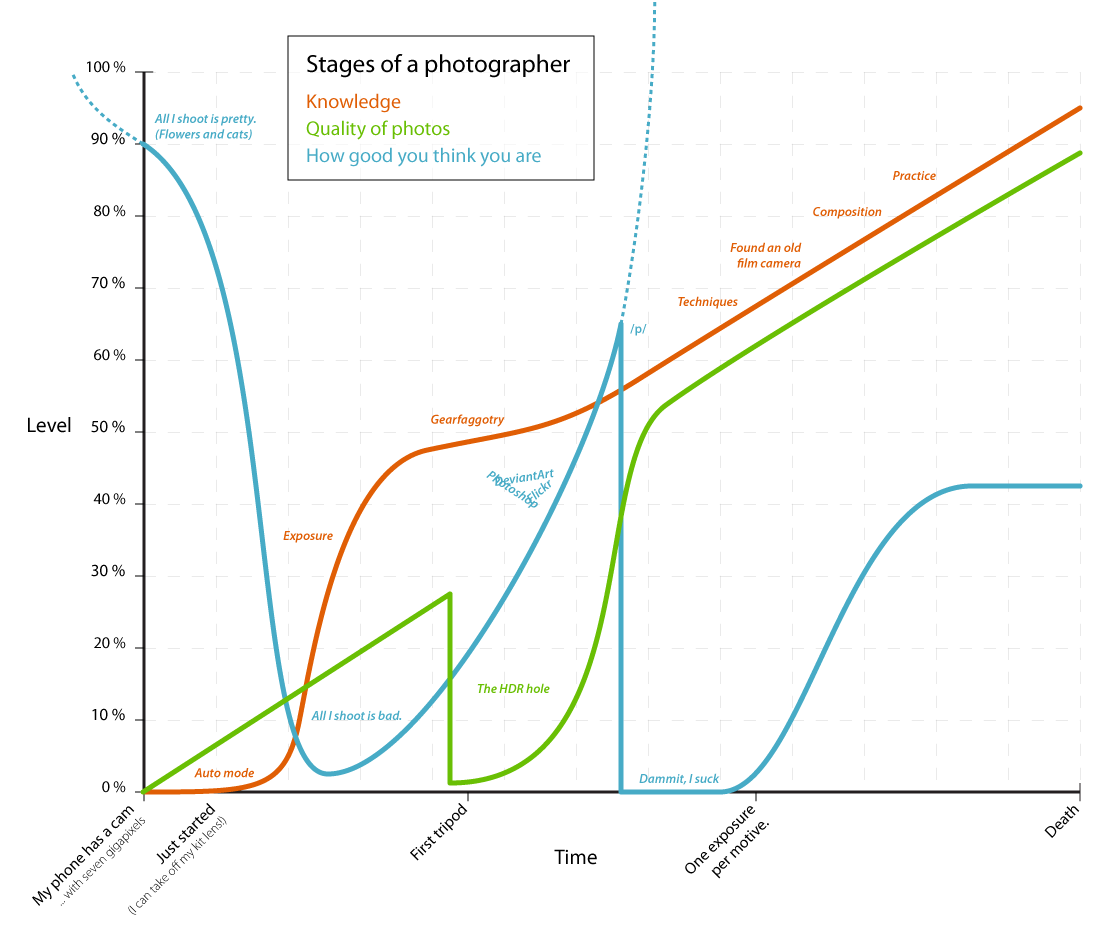
The definitive guide to every photographer's life cycle. Not remarked are the points at which more rational people abandon the pursuit of photography entirely (most just after the "HDR Hole").

On the great timeline of a photographer's life cycle, I'm just past the "HDR Hole" and working my way back up in opinion of my work. Not remarked in the graph, however, is the impact of commercial focus in one's practice of the trade/skill/art. It really does function as a flat line, with less permission to experiment with technique leading to atrophied knowledge and thus an anemic quality of photograph. And Redding's description of the pace of creative work is absolutely accurate - my days are filled with work to the point of exhaustion, to the point where creative energy is a thing only remotely available through irresponsible alcoholism ("Jet Fuel", as I've come to call it), and like the "Morning After Test" a majority of those endeavors get passed over in the glazed eyes of a hangover and resigned to a digital graveyard. It makes money, it supports a lifestyle and a family, but so long as it standard there will always be a permanent glass ceiling to the acquisition of the most coveted goal of a creative, self actualization.

That all said, I'm not going to stop my pursuit of photography as a viable business and living. A key benefit of my situation is that, as a freelancer, I set my own schedule, I accept work on my own terms, and am not obligated by the terms of the contracts I sign to engage in the kind of competition Redding's life in advertising obligated him to wrangle. As he mentions, however, we creatives are a self motivated sort, and often saddle ourselves irrationally with lofty goals and obligations for the benefit of those who may or may not reward us for that uncommon drive (the "bean counters"). In my case, I've swallowed the concept of self sacrifice for market benefit hook, line, and sinker. And it needs to stop. I do not want to spend my last moments lamenting creative energies exhausted to sell a few homes, rent a few listings, and make wealthy people a little more wealthy. Because, in the end, they aren't likely to care.

I am taking more vacations now. Enslaved by the commanding reminders, notifications, and e-mails of my Google calendar, I've made it a point to specifically schedule time for myself in advance so as to not accidentally inundate myself with working shoots those specific days (admittedly I'm still perfecting that trick). Two weekends ago I forewent the standard barrage of a dozen or so shoots for a retreat into the Appalachians, and for the first time exercised knowledge and employed experimentation in the creation of astrophotography, a medium I've always admired but never taken the time to indulge. And it was a much needed recharge. So long as I keep committed to indulging such blind freedom from perceived obligation once a month, I think perhaps an otherwise unsustainable machine gun beat of work might actually be that crucially little bit more tenable.

Who says cell phones can't function as stellar cameras when you just don't care?

So I want to thank you, little as it may be worth at this point, Mr. Redding. I want to thank you for being brave enough to deny your own self deception, for being brave enough to look back at your life's body of work and calling it what it really is. Because not many people, at the end of the line, would ever be willing to admit the nihilist futility of a thing so much time was invested in. And in your bravery, I only wish you could know that you've introduced a little much needed perspective to the lives those artists who would otherwise continue headfirst into persistent self delusion. Very personally, I appreciate the reminder that self actualization will not come from overindulgence in the commercially safe, the commercially viable.

I think I might turn off the electronic level in my camera for the first time since buying it today.

Rebuttal to "How Mirrorless Cameras Could Save the Photo Industry (But Probably Won't)"

Perhaps less a rebuttal than more informed counterpoint. Michael Heath, a University of Pennsylvania IT product analyst, was frank enough to divulge early in his article regarding the decline of the camera industry that he is not a working, "professional" photographer (and I insist on using quotes because the definition of "professional" is an ambiguity at best in today's market). By contrast, I've kept my head buried in the bosom of the camera market nearly 15 years, watched it change and evolve in the thick of the "digital renaissance" of imaging, developing and growing among the first generation of photographers for whom digital is the most accessible medium (versus film). Many of Mr. Heath's points make perfect sense, but arguments of causality and correlation inspire a little pushback from somewhere deep in my gut.

I'll start first with possibly the only point outright refutable (which I believe to be an error of shortsightedness, not looking far enough back in the timeline of camera sales). Mr. Heath presents a chart that I've seen far too many times mirrored on various camera industry rumor sites (43Rumors, MirrorlessRumors, etc.). The chart portends to show declining interchangeable lens camera sales in regular cycles since 2012, which certainly is not incorrect (whee, double negatives).

DSLR vs Mirrorless Camera Sales from July 2012 to January 2015,
generated from CIPA aggregated data on www.personal-view.com.

This chart has always struck me as little more than superficial competition fuel for the inane DSLR vs Mirrorless camera feud plaguing the already brand-loyal tribalist realm of the ILC consumers. Cameras in these categories are not broadly competitive with the smartphones it is suggested they're up against. What is more telling is reaching back to when the original iPhone was released and analyzing the brutally fast disappearance of the compact camera market, the true competitor to the smartphone.

CIPA Camera Production aggregated data from 1933 to 2013,
presented by PetaPixel.com from Sven Skafisk.

It should be telling that the smartphone category of cameras extends well beyond the confines of this chart so as to make it at all reasonable to fit in a rectangular, web friendly box. By 2013, the smartphone portion of the digital camera market extends to nearly 1.3 billion units. In the 6 years it takes for the smartphone market to mature, for iPhones to find competitors in Android devices, for apps markets to present offerings like Instagram and Vine and trigger an intense focus on the quality of mobile phone video and photography, it takes only 3 years for the compact camera market to crash from a sales "high" of ~100 million units down to under 30 million, a more than 70% decline.

Now, by comparison, the DSLR and Mirrorless sales manage to remain fairly consistent through this period of smartphone growth. Among consumer digital imaging technologies, they are still relative new kids on the block, and among working professionals there will always be a market for these higher end bits of technology. However, being more working tools in nature, they are purpose built for the accomplishment of very specific goals, namely the intent to produce a higher-end image, and though the working man may certainly abuse his tools, they are nevertheless built to last (else he wouldn't buy/use them).

The camera Mr. Heath describes, the cheap, simple, unobtrusive brick that takes the deliberate thinking out of the equation in the capture of an image, already existed, and has already been overcome by the Darwinian consumer culture of the tech market. Perhaps Michael had never seen this data aggregated before, but it's perfectly clear (to me) that the rise of the smartphone and advent of digital image sharing on the mobile device clearly correlates with the blisteringly quick decline in compact camera sales. With smartphone cameras featuring up to 1" sensors, bright and fast f/2.4 lenses, brilliantly coded software tricks to expand the potential for mobile image capture, and the pertinence of a voraciously media consumptive culture that images be shared immediately, it's not surprising at all that $200 bricks with 1/2.3" sensors, sub par LCD screens, slow boot times, small batteries and no direct web connectivity fell into obscurity and vanished as internet culture evolved beyond their relevance.

Complexity of modern camera designs is certainly off-putting to the typical consumer, but that is because the typical consumer is no longer a viable target audience. That class of consumer has very clearly made its bed with the smartphone and unless camera manufacturers begin partnering with mobile phone manufacturers in maturing the designs of smartphone cameras I don't see camera manufacturers ever courting the typical consumer again. Which is to say they could possibly learn a lesson from DXO in their release of the DXO One, assuming they're even interested in trying to get that market share back.

Producers of Mirrorless ILCs are at an awkward sort of advantage in the current market, the same sort of awkward advantage enjoyed by their predecessors once upon a time. Canon and Nikon have long had firmly entrenched market popularity being the progenitors of autofocus in consumer cameras and the first big engines in the digital age of imaging. That popularity (and profitability) led them to conservative business practices for fear of upsetting their own stability in the established market, hence why compact digital cameras were allowed to atrophy so steadily with the smartphone's rise - they were unwilling to engage in necessary risk to retain market relevance.

Mirrorless camera makers have no such established market for the typical consumer. While more approachable with revolutionary designs and touch screens, they are by and large intended for the photography enthusiast, much like the entry level DSLR designs of Canon and Nikon. Having once placed enormous faith in the viability of the typical consumer market to carry them with profit-by-volume, Canon and Nikon remain unwilling to bend in established design trends for fear of destabilizing even their "prosumer" markets, and thus even that market will be allowed to atrophy and slowly whither. Mirrorless manufacturers have nowhere to go but up in their camera divisions, given that they never had any established market position prior to 2008 (just before compact camera sales took their nosedive). The freedom of no expectations or established trends allows for greater innovation in Mirrorless cameras, seen in unique processing engines, innovative shooting modes and integrated connectivity to the smartphone (just look at Olympus' E-M5 Mk. II and its art filters, story mode, high resolution shooting with IBIS and amazing WiFi app). Mirrorless may thrive just fine ignoring the typical consumer, maintaining focus on the consumer with a preconceived goal of learning photography as opposed to the guy who just wants to tap a screen, share on Facebook and be done.

My friend Rob's E-M5 Mk. II, alongside a Sarnac Pale Ale, because no self respecting
photographer fails to properly imbibe prior to shenanigans.

Mr. Heath is absolutely correct that "every mid to high-end camera... is, essentially, a complicated evolution of the film camera", but I maintain that is by intent and for the best of those cameras and their intended market. I don't suspect the typical consumer would want to use any sort of boxy touch screen device with some phallic optic extending uncomfortably forth from its body. The form factor alone simply does not align with the expectations of an imaging device set forth by the mobile phone market. It's simply not a war worth fighting, and that's okay. Capitalism may emphasize the value of vigorous competition, but in this situation I believe technology would benefit greater overall by the collaboration of camera manufacturers and mobile phone manufacturers. The availability of such powerhouse rendering engines such as EXSPEED or TRUEPIC integrated in a mobile phone, with tailor made optics and a great underlying sensor to match, would be fantastic.

That said, the camera market is indeed "...at the precipice of a permanent contraction", and personally I find that both true and inevitable for the likes of Canon and Nikon. Like the big banks of 2008, they're used to a lavish "lifestyle" funded by compact camera sales that they'll never get back, and their conservative approach with their higher end camera designs is losing them market share slowly and steadily among working professionals. For the likes of Olympus, Panasonic, hell, even Leica and Pentax, they never developed a crutch out of their compact cameras offerings, and were more than willing to cut that fat from their manufacturing budgets in the last couple years. They are more than sustainable with their appeal to the prosumer and higher end camera market, and at least in the case of Olympus, even profitable.

Sony I choose to abscond from in comment. They make the imaging sensors used by the majority of the market anyway, so making cameras for them is more or less masturbation.

A final note, I'd like to address the multitude of comments decrying the human species for became fat and lazy and incapable of wiping its own ass for sake of not wanting to learn how to use the toilet paper roll. Photography, as a social ecosystem, is remarkably dense and ultimately unaware of itself. It feels unfair, to me, to hold the Average Joe up to the same standards of curiosity and desire to figure things out, to "do it right", as I hold myself to (and as I've assessed, most photographers hold themselves to). It is no new thing that Mr. Average Joe wishes for doors to open for him, for the toilet to wipe his ass (I believe it's called a bidet), and that his camera will do the picture taking for him. Being denizens of this tight ecosystem of curious, DIY-minded people, we've come to expect such enthusiasm toward the exertion of effort as we find for ourselves, but that's simply not the case. This is not to say we are "better" people for our insistence on learning the intricate, underlying workings of how a machine operates and how to operate it most efficiently, simply different, because frankly not all things require such exhaustive study and often times we wind up reinventing the wheel (just because you did it differently does not mean your did it better).

On the whole, a good read from Mr. Heath, and I appreciate his vicarious motivations to get my mental gears a-turning!

Wednesday, August 26, 2015

Workspace

Pardon me while I take a moment to complain.


There is often a lack of attention given to one's working environment. In an office, layout of spaces is a facet of efficiency, how many bodies can be reasonably crammed into single space (or so that it my experience as far as offices go). In the creative industry, work space layout is less restricted by the demands of absolute efficiency, but when one's work space is ultimately one's home, the parameters by which it is constrained amount to where it can fit in amid the necessary trappings of day to day life. Herein lies my complaints about my current living situation. My home does not have the space to accommodate the kinds of creative activity I'd like to indulge.


Home for me is humble, a two bedroom apartment shared with my partner and our pet bunnies and bearded dragon. Our kitchen and living room are something of an open concept space just past the front door, once bedroom functions as the bedroom its meant to be and the other serves as a shared office. And that's it. Room to keep studio lights set up, room to even set them up temporarily and tear them down, does not exist. And as much as the mutual office is great for those nights spent relaxing and playing games with my partner, it's a piss poor environment in which to engage in the very private and personal exercises of anything akin to creative work, be it photo editing or, in this case, blog writing. It's becoming a critical problem for me as I'm growing in my photographic work.

The loathed office. Ideal for cooperative gaming,
appalling for actual work, creative or otherwise.

Particularly bothering me tonight is the desire to write, about which subjects to write, and flesh out mature photo essays on subjects of interest. The need to avoid diversion is obvious, but in such a small home of universally shared spaces they are impossible to escape. To gather the focus to even write this bitchfest of a blog post I'm sitting in the living room to avoid the diversion and self consciousness associated with working on such material with eyes potentially over the shoulder, but even now the activity of the bunnies and eternal allure of white noise on the TV is an overwhelming distraction. The patio of the apartment complex isn't an improvement, what with the droning buzz of dozens of air conditioning units, sirens in the night air and planes flying in to land at the nearby airport. For once, I understand the appeal people find in moving greater and greater distances away from development and civilization.


Even in the exercise of creating half assed blog posts,
the M. Zuiko 7-14mm f/2.8 plagues me with lens flare.
Ideally I'd be writing on any number of topics cataloged in a running list amid the solitude of a quiet basement, perhaps with lyric-free ambiance playing in the background, and with the room to set up a reflective table, take a few snaps of the night's subject, quickly process commit them to my usual verbose prose. Tonight, the best I feel capable of doing is complaining about not having a place to set up such a studio apparatus, snapping a few photos of my miserable work spaces and sharing the claustrophobic realms in which I do my work, all the while gripping with a pang of guilt knowing others work in far more miserable spaces and don't feel nearly as compelled to complain. My standards are admittedly high.


Possibly the only place in my humble abode capable of
providing me any semblance of necessary solitude for work.
To get absolutely basic with my complaints, it boils down to displeasure in the shared office and hatred of my computer desk in general. Creativity, for me, requires a strong sense of privacy, and space in which to self express is a necessity. I simply can't get that here. The simple solution is to move, but this isn't the cheapest area of the contiguous United States in which to live, nor is the process of moving particularly stress free. A standalone studio space was a brief thought, but effectively snuffed when it amounted to effectively doubling monthly rent obligations for less space than simply waiting a couple more years, saving and buying a house with the same amount of room for a single, smaller mortgage payment. Patience, as usual, is the deciding factor.


I'm done, for now. A temporary solution can be found, and I have admittedly spent more time being annoyed than being inventive with solutions to my perceived space constraints. Now pardon me, a bunny just hopped into my lap and it's suddenly hard to type, even to complain.


As an aside, the images above were quickly snapped with the M. Zuiko 7-14mm f/2.8. I've been using it extensively in my real estate work for the past 2 months, and on the whole it is a huge upgrade from the limitations of the 12-40mm f/2.8 when it comes to the wide end. I've come to find the 8-10mm focal lengths indispensable in my work, and after years of finding the 12mm focal length in both the PRO zoom and f/2.0 prime lens variations more than wide enough, suddenly that focal length feels utterly limiting.

Flare, however, persists in being an issue with the lens. Most of the time I've been able to work around it either by intelligent positioning or using my hands to shield hard light sources, but it's nonetheless problematic. With nothing else in my optical arsenal to compare it to, however, I'm still unsure if it's a deal killer for the lens or simply life as usual with such ultra wide optics. My use cases are never particularly easy, of course - contrast laden scenes are endemic to interior photography.

Tuesday, July 28, 2015

Severe Burnout


I've been getting to this point too much this year. Almost catatonic from exhaustion due to unrelenting activity on every front. Possibly still driven forward by momentum, but ultimately losing all will to continue running this sprinter's pace. Lowest priority areas of life begin to suffer, quickly joined by their brethren less-important duties and sense of responsibility, until it piles up into a mountain set to match the magnitude of one's idealized undertaking, suddenly making it so much less appealing an objective to strive for.

Not quite at that latter point yet, where failings match accomplishments, but I can feel myself getting there much earlier this year than ever before.

Arguably it's a great problem to have, or so everyone insists it is and thus it has become my foolish mantra to keep motivated and running, always running. Still stable and steady in the classic 9-to-5 job (although always feeling like I'm failing to fulfill some duty in some way, perhaps because there isn't actually enough work to keep me 100% engaged for what seems an arbitrary 9 hour day). Bread and butter work with contracted real estate ventures are unendingly steady, maybe even easy for the level of effort expected under my contract. Independent work with new clients is booming, with weddings, private real estate work for management firms and investment groups, portrait sessions and band photography and open house events and stage shows... It doesn't stop. Every day I come into the office to work the safe, secure, tried and true 40-hour work week, but someone, somewhere, calls upon my services in an inescapably slim time frame that ultimately interrupts the normal pace of the work week and always leads to exsanguination of time off. My vacation days aren't spent on vacations, they're conveniences that allow me to leave one job early to go work another. A trend that began last year and has only solidified as a new status quo in my working life.

And I'm tired.

I'm editing shoots from the weekend on my evenings during the week after a 9 hour day of office droning, fighting with software and swearing under my breath for lacking support for new tools (seriously, DXO, please get that M. Zuiko 7-14mm f/2.8 lens module out soon). Until midnight each night I edit, reset, edit again, reset again, sifting for "looks" that work for the client until finally slapping together the best I can and shipping the package over some cloud service that takes another hour to complete the upload. Up again at 7:00AM the next day, this time burning through 4 hours of time off for a "quick" shoot in Baltimore or DC, or a dentist appointment, or a vet visit (pet bunnies, you know). I try to make up the hours later in the evening, but the building closes and I'm nowhere near made up for the time I missed, so more time off goes out to make up for it. The weekend comes and my friends are thrilled to have BBQs or go out to the bar or go hiking out west toward the mountains, but I can't join them because I'm running contracted shoots from 10:00AM until 5:00PM the next day, driving from Baltimore to DC to Annapolis in a sloppy route that costs too much in gas and is insufferably hot in my AC-broken-for-6-years car (aptly nicknamed "The Toaster"). Sunday it's the same thing, only there were accidents on all the major highways so I don't get home until 7:00PM that day.

Sometimes I drive out to my Mom's place in Virginia if I end my Sunday tour on the west side of DC (an extra hour drive, but it's the most opportune time to visit her and she calls, missing me, pretty often). I want to talk with her, have conversations about life and where we are and how much I miss her and don't know who she is for sure anymore and am pretty sure she feels the same way, not knowing who I am either. But my brain is fried, I've been running around meeting clients and running shoots in the blistering heat for days and all I can do is sit on her couch and focus on Business Stuff because that's all that's been running through my head for months. I get home around midnight, edit photos from the day's shoots until 1:00AM, decide "This is stupid" and pass out alone in bed because my boyfriend has been stuck sleeping nights with a non-conformist body rhythm, so he'll slip into bed right when I get in the shower and for all intents and purposes I won't see him at all. Not just for that night, but for days.

I'll work Normal Office Work the next day, get home, realize I'm spending the evening alone, and rationalize staying home and drinking too much as the better, the safer option, rather than call up a friend or venture out to the same tired places I've photographed a million times on my own. I'll punch at photos in a drunken nostalgic stupor and suddenly feel like a million bucks, maybe post one or two images edited in this inebriated clarity on Flickr, get pissed off at the glitchy and cumbersome groups system, play a round of Hearthstone, get tragically stomped, then trudge into bed without even brushing my teeth. I'll sleep in late because the alarm is twitchy and doesn't go off reliably, shower and rush out the door for more Normal Office Work, then suddenly feel crushed under the weight of obligation throughout the day as dozens of emails pour in inquiring about my availability to photograph XYZ specifically within the window of Normal Office Work business hours. I'll capitulate, stick a reminder in my schedule, and get ready to hemorrhage more time off to make more money than those hours would otherwise be worth doing this little side job, forgetting to account for the hours I'll spend that evening editing things and losing what little time I have to spend with my boyfriend in the process.

This level of activity happened twice last year, once in the Summer (but not quite as heavily) and once in the Winter (which set a new baseline for the amount of stress my body and mind are able to tolerate). Every year has seen a lull around February and March, but that lull this year was more akin to a return to what I considered "normal" business activity levels. Things picked up in full force by mid-April and have steadily augmented in intensity since. Steadily may be the incorrect word. Exponentially sounds more realistic as it relates to the volume of labor involved. I've taken one actual vacation day for a trip to Pittsburgh a couple weeks ago. I paid for my audacity in taking a vacation by pouring my time into "make-up" photo work during the work week, staying as late as I could upon returning to the office to make up for time lost but still never quite getting to that golden 40-hours. I've gotten sick twice this year, which is supremely abnormal for me, and both times it was bad enough to land me at home for a week after a doctor visit, again a rarity for me. My body is responding in kind to the stress I've applied to my mind.

I write blogs a lot more when I go through these periods of extreme stress. It's an incredibly helpful medium by which to release the pressure, like screaming into an empty room. And right now exactly what I need is a good scream. There is no point to this post other than to reverberate the walls with a cracked and squealing scream that sounds curious like the furious stamping of fingers on keyboard keys. But that's okay, because already I'm feeling a little better having stamped those keys through the plastic and down to the desk, leaving little imprinted letters in their wake.

Might my situation be a scenario from which to learn for you budding workaholic photographers out there. Pace yourselves, and do it both actively and with regular rhythm. You are useless once you've burned up into a sad and stupid pile of ashes, scattered to the wind like you never even existed.

Monday, July 20, 2015

Panasonic Leica 42.5mm f/1.2 DG Nocticron, or "The Joy of Subject Isolation"

First, a little backstory

It's nearly been a year since first acquiring the Olympus E-M1 paired with its quite fantastic kit 12-40mm f/2.8 PRO zoom, and it seems in general that this past year has been marked exclusively by similarly stellar PRO badged zoom offerings. All of which are great optics, and extremely useful and even gorgeous in rendering of scenes, so please don't allow my ensuing love affair with the abstract magic of an off-brand (not really off-brand, just not Olympus brand) prime lens suggest disdain toward those remarkable zooms.

You see, prior to those PRO zoom offerings, I was exclusively a prime lens shooter for years, ever since 2008 when I picked up the Nikkor 35mm f/1.8 G DX lens for my old workhorse Nikon D40X. It only ever took that one lens to set me on the elitist track of prime optics fanboyish-ness, and since then my kit had always been an assemblage of ~f/1.8 lenses at fixed focal lengths between 12mm and 45mm, at least until August of 2014. Once the strengths of Olympus' line of PRO zooms sank their teeth into me, I made it a goal to relearn how to shoot with zooms (a lot harder than one might realize after spending years refining skills in fixed focal lengths). For purposes of photography-for-work, it was a critical skill to refine given the fluidity of working photographic endeavors. But the last 2 weekends hadn't seen a tremendous amount of photography-for-work. Instead, it was all road trips and casual outings and the remarkably fun time I seemed to have lost sight of somewhere down the road in becoming a photographer-for-hire with good business sense. And very quickly I yearned for the refining limitations of a strong prime lens, a tool to slow me down and consider the scene prior to snapping a single frame.

I frequently run with the M. Zuiko 17mm f/1.8 on the E-M1, easily one of my favorite prime optics for the vast majority of situations. The backup PEN E-P3 typically keeps an M. Zuiko 45mm f/1.8 on it at all times when a greater sense of subject isolation is called for. These primes have been in my kits for years, and like all things that become regular staples to one's routines, they are a little stale to my eyes. Rob, my friend and regular counterpart in photography excursions, picked up the Voigtlander 17.5mm f/0.95 a couple months back, and seeing his results with that lens never fails to impress me. With his keen sense of composition, the kind of soft and smooth falloff of focus and sense of subject isolation have me salivating every time I see a new image hit his gallery. It was that kind of subject isolation I really wanted translated in my images, and with the limitations due to sensor size of the Micro Four Thirds format I knew it would never come without investment in some ridiculously fast glass like the Voigtlander series of f/0.95 optics.

Or... a rather quietly heralded optic from the other side of the MFT fence, in the Panasonic realm. I remembered much excitement over the Panasonic Leica 42.5mm f/1.2 DG Nocticron, nearly as much as I remember the legions bemoaning a poor value proposition from the cost:benefit standpoint. Indeed, while reviewing the lens through the experiential retellings of Tyson Robichaud and Steve Huff, the lens was the stuff of dreams ever outside the reach of the hobbyist or amateur for sake of price, especially for a prime (at least when the value prime propositions in the MFT field are so dauntingly numerous).

My situation today is very different from even a year ago. Once upon a time I fit into that hobbyist amateur category, and such belligerent notions as dumping $1600 into a lens... I couldn't have done it if I wanted to. Very quickly in the last year I seem to have crossed a threshold in the business sense, wherein one finds himself unexpectedly making too much money and faces tremendous consequences come tax time should he not be able to spend it fast enough to compensate. Most people say it's a good problem to have, but it's certainly a weird one in which conventional thinking and approaches to business budgeting become encumbering anxieties.

The point of divulging this bit of detail is to explain the frame of mind necessary for me to personally justify the expense required to attain this lens. For the MFT format it is extraordinarily expensive, and acquisition of new equipment always pairs with perceived risks regarding whether or not the new gear will satisfy the needs for which it was acquired. This lens would have never entered the scope of reason were it not for the fact that I am looking for places to invest my photography earnings. What I am coming to learn, however, is that once one has matured a taste for a style of image, adhering to the tenets of value propositions is absolutely foolish, and an unnecessary setback to the realization of potential. I let this lens pass right through my field of awareness when I saw a price tag I considered too high. I should have had a pre-order in the second it was announced.

Now onto a review-by-experience of the lens

This weekend, Baltimore held its annual Artscape Festival, famed for being the largest free arts festival in the United States with some 350,000 attendees to peruse and purchase the works of local artists and enjoy the concert-like festivities held across several city blocks. As long as I've lived local to Baltimore, I'd never attended the festival despite always having interest in indulging Baltimore's unique affinity for the arts, especially of the fringe, generally weird variety. A friend and enthusiastic performance artist expressed interest in a bit of costuming at the event Friday evening, and requested I join his troupe to photograph both his character and candid reactions of people on his parade through the entirety of the venue. I was more than happy to oblige, and the opportunity to put the Panasonic Leica DG 42.5mm f/1.2 to appropriate test encouraged a fiendish overnighting of the optic to my address by Friday morning.


The inevitable first impression of the lens is of size and weight. The thing is simply massive for the format, very wide and with a large front element that makes me thrilled to have a lens hood to put over it for protection. Assembled with the hood and on the E-M1 with vertical grip, it looks like it should fire some sort of projectile ordinance, which may be inconsequential and extremely shallow a judgment of appearance but it's no doubt empowering to the brain of the typical American male. Burdened with so much glass and encased in sturdy metal housing, it all but pulls the camera body to the ground, clearly eclipsing the body, even with vertical grip and extra battery, in weight. Thus it is slightly less balanced in use, but nothing unresolved by supporting the lens where the hood affixes to the chassis. Suffice to say, it is as formidable an optic on the E-M1 as the M. Zuiko 40-150mm f/2.8 PRO zoom, only condensed as if the zoom were squished down into a tighter barrel of glass and gears.

An oddity that is perhaps only odd for sake of never having noticed it before is the sound of the aperture clicking furiously when the camera is to set to P-Auto. It's been a force of habit in using the PRO zooms over the last year to stick with P-Auto and simply turn the dial to open the lens aperture if so desired for any given shot. On the zooms and even the tiny M. Zuiko primes I never noticed the sound of the iris blades switching between different positions as the camera automatically adjust for exposure in the scene before it, but even in the hustle and bustle of a restaurant I can hear the aperture blades stopping down and stepping up furiously as the lens is pointed randomly toward different intensities of light and contrast. For the first time in some years, I'm using Aperture-Priority mode once again to assuage the noise, which makes plenty of sense given my primary motivators for acquiring the lens were for the speed of f/1.2 and subject isolation potential of such a bright aperture.


We agreed to meet at The Brewer's Art, a very cool locale on Charles Street just a couple blocks south of the greater Artscape festivities. Given my friend's need for discretion in his transfer into costume, he picked quite literally the darkest spot in the dim-by-intent basement bar, a little booth lit strictly by a pair of candles on the table, surrounded on three sides by walls with no windows. Of course we ate, and being famed for its selection of local brews we would have been considered rude for not sampling at least one beer.


With a tacit measure of guilt, I enjoy photographing food and drink when out with friends. Traditionally I use the wide M. Zuiko 17mm f/1.8 with its comfortable close focusing distances. Friday I made it a point to strictly bring the Nocticron and no other lenses to forcibly learn the nuances of its use and optimal function (no better way to learn a lens than slam your head into a brick wall trying to make it do the things it wasn't designed to do). Photographing the beer at Brewer's Art, I was sad to find the minimum focusing distance of the lens less than friendly for close-up snaps. Not that it would ever be reasonable to expect an 85mm equivalent focal length to make sense let alone functional well for photographing food or drink right in front of you on a table, but I suppose I was secretly hoping for a bit more macro focus than the M. Zuiko 45mm f/1.8. In practice, both lenses appear to have about the same minimum focusing distance. But really, that's just fine.

The snap above (SOOC JPEG) was lit by a candle and the soft glow of my cell phone's screen from behind. At f/1.2, ISO went up to 3200 to keep the shutter speed at a comfortable 1/100". Were I to step back and take this snap again, I feel confident I could've dropped the shutter speed to 1/30" to pull back the ISO, but it's rather stellar that this kind of exposure works out regardless given the abysmal lighting conditions. Using the 17mm f/1.8 in similar circumstances, ISO tops out at 5000 and never goes down, more often than not underexposing on account of the arbitrary ISO cap (something I set up in the E-M1 to avoid extension mode ISO values). Even if only 2/3 faster by light transmission (T-Stops), f/1.2 is absolutely worth the investment. I'd love to see a 17mm f/1.2 DG Nocticron, if not something from Olympus as has been rumored to be in the works.


Properly stuffed and adequately imbibed, it was time to join in the spirit of Baltimore's overarching shenanigans amid the Artscape scene. I patiently stood guard at the head of the table while my friend switched from his less "loud" personage into intended attire; tall boots and a bright red overcoat, capped off with a remarkably detailed and intricately constructed horse's head mask, matched by similarly constructed hand pieces and a classic (and literal) pony tail. The Horse Jockey, exuding both the class and absurdity that defines much of Baltimore's art scene.

It wasn't enough to simply wander right out into the street. Staff at The Brewer's Art had seen plenty of interesting things pass by their doors in the few hours festivities had been ongoing, now they had a spectacle inside their walls. Equus, the chosen name for the unicorn-horse-jockey character, approached the upstairs bar with a measured cadence to his stride, leaned over the counter and politely requested the bartender's draft of choice.


In better (but still not great) light and remaining at f/1.2, this first actual snap with the lens left me quietly thrilled. Zones of light that would normally call for ISO 3200 with an f/1.8 prime are more than content at ISO 400 at f/1.2 (as the E-M1 sees fit to meter the scene and adjust settings compared to the M. Zuiko 17mm f/1.8), and the sharpness, even this wide open, is dumbfounding. By comparison, and the larger basis of my rationale for acquiring the Nocticron as opposed to a Nokton, Voigtlander ultra-fast primes are markedly soft when opened up to their f/0.95 majesty. Plenty applicable for wedding photography wherein a soft look is part of the appeal, but being more inclined to introduce grit and haze in the post-process, I want crisp edges and clearly defined texture, a clarity not even fabled full frame f/1.2 "dream lenses" from Nikon and Canon provide. For all the compromises of Micro Four Thirds as a format, I am thrilled to concede on many fronts for sake of the wonders of optical engineering possible for their sake.


Wandering into the streets, we made our way north toward the music and crowds of Artscape proper. Keeping a haughty stride and demeanor about himself, Equus commanded the attention of onlookers already taken aback by the very Burning Man-esque atmosphere of the festival.

Having never been to Artscape before, it was certainly a neat thing to see for my part. Block after block of vendors dealing in their respective mediums spanned what felt like miles of territory. Leatherworkers sold elaborately decorated and hand-stitched bags, photographers and painters alike sold smartly packaged multi-piece series of work which, when fully assembled as a purchased set, created amazing panoramic overarching pieces of art that would fill a wall's worth of space. Stages set up at the farthest reaches of each block featured different musical artists indulging their art with high energy, exciting their respective crowds. Possibly my favorite setup was Bit Gen, a video game-themed exhibition replete with ornate 8-bit-style decor, antique arcade cabinets beside game developer showcases, and a center stage featuring the appropriately dorky rhymes of local Nerdcore artists (for the uninitiated, rap-for-nerds).


A spectacular experience, an ideal expression of the inarguable weirdness that defines Baltimore. For all the negativity that defined its narrative as a broken and inexcusably corrupt hellhole, it was a joy to step into a crowd with mutual respect and understanding for the awkward struggle the city has always had in establishing its own identity, portrayed in fantastic fashion by the seemingly random showcase of traditional/modern/contemporary arts crammed into a music festival venue. All the while, absorbing the chaos of it with an ear to ear smile, here I was walking around with a unicorn-man in a jockey's coat in 90-degree weather being overrun by festival goers eager for that ever elusive unicorn-selfie.


All above images are SOOC JPEG copies, processed from RAW in-camera, transferred to my phone, backed up to the cloud automatically via Google Drive and now ultimately present here. Many steps of compression from start to finish, but it was important to me at the time of this very unique photo walk to upload captures immediately to the likes of Twitter and Instagram. I speak on the prevalence of the mobile image nearly as much as I disparage the transience of the image such a voraciously consumptive culture encourages, but today I am resigned from that battle and choose instead to embrace that culture openly (and am admittedly already happier for it).

Focus with the Nocticron is just as fast as I've come to expect from Micro Four Thirds glass, snappy with minimal hunting in good light and smart enough to average out the faces in the frame to lock focus at the happy medium. Despite the quick falloff of focus inherent to the f/1.2 aperture, the distance between photographer and subject required by the 42.5mm (85mm equiv.) focal length reasonably well diminishes issue with the effect (this despite the fact that, with a single subject, focus will readily fall off at the ears). I did not buy this optic for the purposes of what is essentially snap shooting, but it held up as well as it ought to in such practice. Such shots as above are just as easily served by much more accessible optics such as the M. Zuiko 45mm f/1.8 or Panasonic's recent 42.5mm f/1.7 release, but I was happy to know the size and weight of the focusing elements of the lens did not cause any sort of lag in autofocus that would otherwise relegate it to staged portrait work.


Not unexpectedly, the crowds became a bit overwhelming for Equus, and we made a subtle retreat from the bustling evening scene of Artscape toward a more private venue for sake of my request to test the new lens' capacity to produce the sort of photos for which one purchases such fast glass. Artscape occupied the blocks just south of Baltimore's iconic Graffiti Alley off North Avenue, thus it seemed an obvious and ideal locale toward which to wander.


For some time I've considered picking up a full frame body to attain the sort of subject isolation that always seems so out-of-reach for the Micro Four Thirds format. Physics only bends so much, and optical engineering will never become a cheap process capable of magically high-grade assemblies producing amazing sharpness at f/0.7 to recreate the sort of shallow depth of field possible with full frame f/1.4 optics. That in mind, however, I admittedly suffer from grass-is-greener mentality because I have never used such high speed optics on full frame, and from all accounts that I trudge up from my peers in photography seem to return to the same point - to make those lenses reliable in practice, you're stopping down a bit.

The "look" of wide open aperture on such fast full frame glass is intoxicating, but I am even willing to compromise in the matter for my own purposes to attain the sort of focus falloff of those optics at f/2.8. And that's essentially what I get with the Nocticron, and it excites me tremendously. Despite their light capturing ability, even the short telephoto M. Zuiko 45mm f/1.8 prime left images looking just on the borderline of flat and genuinely 3-dimensional. The Panasonic Leica 42.5mm f/1.2 DG Nocticron, however, is right where my arbitrary sweet spot is in regards to width of the focal plane. It's a kinda of super subtle nuance to how it renders images, the difference being so imperceptibly tiny that only after 4 years of photographing under the limitations of f/1.8 on the format would it ever be noticed. I notice it, and could never be more thrilled to see one more barrier, one more glass ceiling, broken from the repertoire of "looks" of which I am capable on the Micro Four Thirds format.

I mentioned before the alienating impact of the steep price point at which the lens resides. The Nocticron is, to the uninitiated, an absolutely abysmal cost:benefit proposition from the very concrete and quantifiable metrics to which the engineering minded of the photography community are so steadfastly committed. From the viewpoint of the artist (of which I am adamant that there is an artist tucked somewhere deep in all of us), it is absolutely valuated right where it should be. Like luxury cars and high-end audio equipment, the differences on paper are minimal and arguably inconsequential, but the refinements for which one purchases a good at this luxury price point are such wonderful subtleties to those who are weathered initiates of their art.

Thus I could not discourage the casual photographer more from the purchase of this lens, nor the hobbyist, nor the engineer, nor the rich world traveler. This is a tool for the artist with a very clear and specific preconceived vision for the kind of image to be created. A tool of specific intent, and absolutely not an experiment or impulse buy.

That said, I suspect I will very soon hunger for similarly nuanced falloff in the 17mm (35mm equiv.) focal length very soon. Quite possibly the next time I dare to take the Nocticron off the E-M1 on personal excursions, which I find... remarkably unlikely for some time.


By sundown we were exhausted from the marathon march through the heat, opting to close out our evening like old men and turn in before the nightlife crowd surfaced through the concrete and asphalt. It was a great experience at the festival, a great time chaperoning an eager and outgoing performer. So great in fact I stopped by the next day, albeit with less fanfare and less deliberate aim, simply to people watch and ingest the art around me in all its variety and (sometimes) weirdness.


I think I'll go again next year.